




Choosing a Technology Stack for Your Dating Startup: Backend, Frontend, Mobile
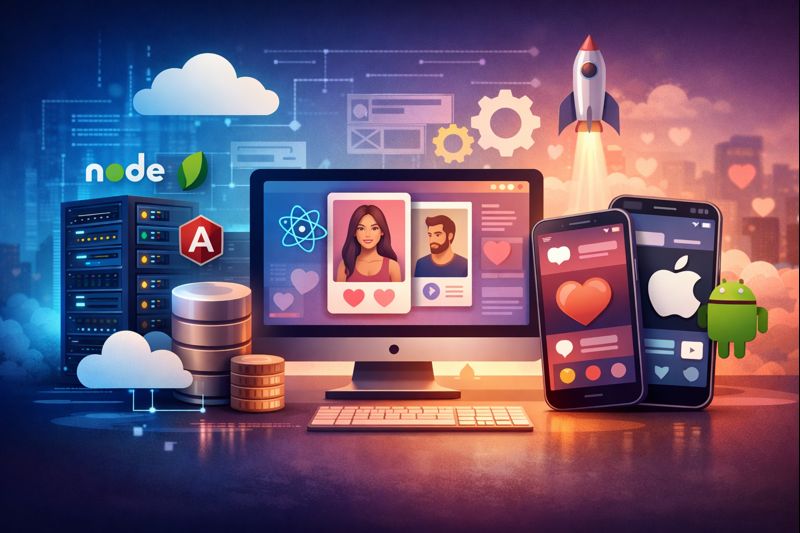
Every successful dating startup begins not with a flashy interface or creative marketing, but with a fundamental decision—choosing the technology stack. Imagine this situation: you launch a dating app, early users register en masse, friends share the link on social media, but within a week the server crashes under load and the database freezes while processing swipes. Sounds like a nightmare? That’s exactly why the right technical architecture determines whether you’ll become the next Tinder or remain in your competitors’ shadow.
Why the Technology Stack Isn’t Just a Developer’s Choice
When people talk about technology stacks, many imagine incomprehensible programmer jargon. In reality, it’s your foundation—a set of tools from which the entire application is built: the beautiful interface users see (frontend), the invisible server-side part processing all actions (backend), databases for storing profiles and messages, and cloud services for chats and notifications.
These decisions determine three critical factors for any startup: whether you can scale as your audience grows, how much time it takes to launch a minimum viable product (MVP), and what your monthly maintenance costs will be. Dating applications are particularly demanding technologically—they require instant message delivery, precise geolocation for finding nearby matches, and reliable protection of millions of users’ personal data.
How Apps Used by Millions Are Built
Before building your own platform, it’s worth looking at how market leaders did it. Their experience is your roadmap, helping you avoid costly mistakes.
Tinder: Betting on Development Speed
Tinder’s creators chose React Native—a technology that lets you write code once and launch the app on iPhone and Android simultaneously. This cut development time in half compared to creating two separate applications. The server side runs on Node.js—a technology especially good at simultaneously processing millions of swipes and messages.
An interesting detail: Tinder stores user profiles in MongoDB—a flexible database that allows quickly adding new fields to profiles without rebuilding the entire system. And to speed up performance, Redis is used—a special storage that keeps the most popular data in fast memory, making swipes instantaneous.
Bumble: When Perfect Performance Matters
Bumble took a different path, choosing native development—separate applications for iOS in Swift and for Android in Kotlin. Yes, it requires more resources, but users get maximally smooth animations and instant interface response. When your competitive advantage is convenience and speed, every millisecond matters.
Bumble’s servers also run on Node.js, but special attention is paid to personalization: artificial intelligence based on Python and TensorFlow analyzes user behavior and suggests the most suitable matches. This isn’t magic—just smart use of modern machine learning technologies.
Hinge: Balance Between Speed and Quality
Hinge chose a compromise option: React Native for the mobile app, but with TypeScript added—this makes code more reliable and reduces errors. The server side is built on Django—a powerful framework in Python that offers protection against most hacker attacks out of the box.
This approach is especially suitable for startups that want to quickly enter the market but plan to implement complex matching logic. Django allows rapid development of business logic, while built-in security mechanisms save months of work.
Mobile App: One Codebase or Two Separate Projects?
The first question every dating startup founder faces: should you create one app for both platforms simultaneously or develop separately for iOS and Android? Let’s break it down without technical jargon.
React Native—When Budget and Time Are Limited
Imagine hiring one development team that writes code once, and you get two ready apps—for iPhone and Android. That’s exactly how React Native works. Time savings amount to 30-40%, meaning you can launch your MVP 2-3 months ahead of competitors.
This technology is perfect for classic dating app features: profile creation, browsing profiles, swipes, chats, push notifications. A huge developer community has created ready solutions for camera, geolocation, and even payment system integration—you don’t need to reinvent the wheel.
There are nuances: if you plan complex visual effects or want to use the newest iPhone or Android features, React Native may require additional adjustments. But for 80% of dating startups, this choice is optimal—fast, affordable, and effective.
Native Development—Investment in Premium Experience
If you have a serious budget ($100,000+) and want to create something truly unique—real-time video calls, AR masks for photos, complex 3D animations—then it’s worth investing in native development. Two separate apps in Swift (iOS) and Kotlin (Android) give maximum control and performance.
Yes, development will cost 50-70% more, and you’ll need two development teams. But the result will be felt in every finger movement: the app works faster, consumes less battery, and the user experience is on par with the world’s best products. Bumble didn’t choose this path by accident.
How to Choose for Your Project
Ask yourself three questions. First: what’s your starting budget? If it’s $30,000-50,000, choose React Native—you’ll get a working product on both platforms. Second: how unique are your features? Standard swipes and chats—React Native; innovative features like video or AR—native. Third: when do you need to launch the MVP? If time is measured in months, cross-platform development gives you a six-month head start.
The Server Side: Your App’s Heart
While users see a beautiful interface, all the real work happens on the server. It’s the backend that decides who to show in the feed, delivers messages, processes subscription payments, and stores millions of photos. The choice of server technologies determines whether your platform can withstand an influx of users or collapse at the worst possible moment.
Node.js—Ideal Choice for Chats and Notifications
Node.js was created specifically for apps where thousands of people simultaneously chat, swipe, and receive notifications. Its secret lies in the ability to process many actions in parallel without making users wait. Sent a message? It’s delivered in a fraction of a second via WebSockets—a technology of constant connection between app and server.
Another plus: both the mobile app and server can use one programming language—JavaScript. This simplifies hiring developers and speeds up development of new features. No wonder both Tinder and Bumble chose Node.js.
Django—When Security Comes First
Dating apps work with the most sensitive data: photos, personal information, conversation history, payment data. Django is a framework in Python that protects against the most common hacker attacks out of the box: SQL injections, cross-site scripting, and request forgery.
But Django’s main advantage for dating startups is easy integration with artificial intelligence. If you want to create a smart matching algorithm that learns from user behavior, Python offers the industry’s best tools: TensorFlow, PyTorch, scikit-learn. Hinge built its reputation on precise matchmaking thanks to Django and ML algorithms.
Ruby on Rails—MVP in a Month
For startups that want to test their hypothesis as quickly as possible, there’s Ruby on Rails. This framework follows the philosophy of “convention over configuration”—most typical solutions are already built-in; you only need to describe your business logic. An MVP can be launched in 4-6 weeks, which is critically important when every month counts.
The only nuance: when scaling to hundreds of thousands of users, Ruby on Rails will require serious optimization. That’s why many startups use it for a quick start, then gradually transition to Node.js or Django.
Where to Store Profiles and Messages: Database Choice
Every swipe, every message, every photo—all of this needs to be stored somewhere. And not just stored, but provide instant access for millions of users simultaneously. The right database choice can save thousands of dollars on servers and prevent catastrophic bugs.
PostgreSQL—Reliability for Critical Data
PostgreSQL is a classic relational database, proven over decades. It guarantees that payment transactions won’t be lost, profiles won’t get mixed up, and message history will be preserved even during server failure. Built-in full-text search allows searching users by interests and hobbies, and the PostGIS extension adds advanced geolocation features.
If your business model is built on paid subscriptions and you can’t afford to lose transaction data—PostgreSQL is mandatory. It’s the gold standard for storing structured information: profiles, messages, user action history.
MongoDB—Flexibility for Rapid Experiments
Startups live in constant change mode: today there are 10 fields in a profile, tomorrow you want to add zodiac sign, the day after—favorite music. With MongoDB you can change data structure on the fly, without service downtime and complex migrations. That’s exactly why Tinder chose MongoDB for storing profiles—each user can have a unique set of characteristics.
MongoDB also scales horizontally excellently: need more space for a growing user base? Just add more servers, and they’ll automatically distribute the load. For startups in active growth phase, this is critically important.
Redis—Your App’s Turbo Booster
Redis is a special database that stores everything in RAM, providing access speed hundreds of times faster than regular databases. Use it for user online statuses (who’s currently online), active chats, and caching popular profiles. Result: the app responds instantly, users are happy, load on the main database decreases by 5-10 times.
Firebase or Your Own Server: Every Startup’s Dilemma
This decision determines 80% of your technical path. On one hand—a ready solution that launches in a week. On the other—full control and predictable costs. Let’s break it down honestly, without marketing.
Firebase—Start Without Server Programmers
Firebase from Google is a ready set of server services: database, file storage, social media authentication, push notifications, hosting. You don’t need a DevOps engineer at $80,000 per year, don’t need to configure servers and think about security—Google has already done everything.
The best part? There’s a free tier that lets you launch an MVP and test it on the first 50,000 users. Setup takes days, not months. Real-time Firestore synchronizes data between all user devices instantly—started a conversation on iPhone, continued on iPad.
But there’s a catch. After 100,000 active users, the monthly Firebase bill can grow to $5,000-10,000. The more popular your app, the more Firebase costs. Plus you’re tied to Google (vendor lock-in)—migration to your own solution later will cost tens of thousands of dollars.
Verdict: ideal for MVP and the first 6-12 months of startup life. You test the hypothesis for minimal money without getting distracted by technical infrastructure.
Custom Backend—Investment in the Future
A custom server on Node.js or Django with PostgreSQL gives what Firebase can’t: full control over every byte of data. Want to create a unique matching algorithm? Implement video calls? Optimize costs for storing millions of photos? With a custom backend, it’s possible.
After the 100,000 user threshold, a custom solution becomes more profitable: you only pay for servers, not for every database request. Predictable costs are critical for business planning and attracting investment.
The downsides are obvious: development takes 3-6 months, you need a DevOps specialist, you’ll have to set up security, monitoring, and backup yourself. For a team without technical experience, this can be a nightmare.
AWS Amplify—Compromise for the Smart
You know what experienced tech leads choose? AWS Amplify—a solution that combines Firebase’s simplicity with custom backend flexibility. You get ready services from Amazon (database, authentication, storage), but with the ability to write your own business logic through serverless functions.
The main trump card: when scaling, costs grow slower than with Firebase. Plus access to the entire AWS infrastructure: machine learning through SageMaker, video streams through Kinesis, global content delivery network through CloudFront. The price—you need basic AWS knowledge, but that’s solvable.
How Dating Pro Solves Technology Puzzles for You
After reading all of the above, you might feel slightly dizzy. Dozens of technologies, hundreds of decisions, the risk of choosing the wrong path and losing months of development and tens of thousands of dollars. The good news: you don’t have to figure this all out yourself.
The Dating Pro team has created its own solutions over the years that cover 90% of dating startup needs. Instead of choosing between React Native and Native, between Firebase and custom backend, you get a time-tested technology stack that already works for dozens of clients.
Real advantages: ready modules for profiles, swipes, chats, video calls, payments are already developed and tested. This reduces development costs by 40-60% compared to creating everything from scratch. Instead of 6-8 months, your MVP launches in 2-3 months—critical time savings in a competitive environment.
Dating Pro uses an optimal combination of technologies based on the experience of hundreds of projects: cross-platform development for quick start with scaling capability, custom backend optimized for high loads, and modular architecture allowing addition of unique features for your needs. You’re not tied to vendor lock-in and fully control your product.
And most importantly—you get not just code, but the technical expertise of a team that knows all the pitfalls of the dating industry: from matching algorithms to App Store requirements, from GDPR compliance to push notification optimization for maximum retention.
Practical Checklist: How to Choose Technologies
Now that the picture is clear, let’s systematize the decision-making process.
If your budget is $20,000-35,000: React Native + Firebase—the classic choice for a quick MVP. Launch in 6-10 weeks, cover iOS and Android simultaneously, minimal maintenance costs for the first six months. Alternative: ready solution from Dating Pro with built-in features—even faster and cheaper.
If budget is $40,000-70,000: React Native + AWS Amplify or light custom backend on Node.js. Timeline 8-12 weeks, but you get more control and more predictable costs when scaling. Suitable if you plan unique features and rapid growth to 100,000+ users.
If budget is $100,000+: Native development for iOS and Android + full-fledged custom backend with microservice architecture. Timeline 4-6 months, but the result is a premium product with unique capabilities: AI matching, HD-quality video calls, AR effects, complex gamification.
By product type: standard dating app (profiles, swipes, chat)—cross-platform development fits ideally. Innovative product with video, AR, or unique algorithms—only native + custom backend gives the needed flexibility. Niche app for narrow audience—you can even start with no-code platforms and ready solutions to validate demand.
Cloud Infrastructure: Where Your Users Will Live
The choice of cloud provider determines how fast the app works in different countries, how much you pay for storing photos, and how easily you can scale during viral growth.
Amazon Web Services (AWS)—the industry standard trusted by both Tinder and Bumble. AWS’s huge advantage is a global network of data centers: users from New York, Tokyo, and Berlin get equally fast app performance thanks to CloudFront CDN. Pay-as-you-go pricing means in the first months you spend pennies, and as you grow, AWS scales automatically.
Google Cloud Platform (GCP)—ideal choice if you plan to implement artificial intelligence. Integration with TensorFlow for ML matching algorithms, Cloud Vision API for automatic photo moderation (detects inappropriate content), BigQuery for deep analytics of user behavior. Firebase also runs on GCP infrastructure, so migration from Firebase to full GCP is painless.
Microsoft Azure—choice for B2B dating platforms and projects with heightened security requirements. If you’re creating a corporate dating app for employees or a dating platform for medical workers with HIPAA requirements, Azure offers the best compliance certifications.
Security: How Not to Become the Hero of Data Breach News
Dating apps are a tasty morsel for hackers: personal photos, correspondence, real-time geolocation. One data breach—and reputation is destroyed forever, as happened with Ashley Madison. That’s why security is built in from day one, not added later.
Basic protection: all data between app and server is encrypted via SSL/TLS—this is a standard that’s non-negotiable. In the database, passwords are stored only in encrypted form (bcrypt or Argon2 hashing), and sensitive data is protected by AES-256 encryption. This means even if a hacker gains server access, they’ll only see a meaningless set of symbols instead of real data.
Authentication: login via Facebook, Google, or Apple Sign In isn’t just convenient for users—it’s an additional security layer because Google and Apple have already verified identity. Two-factor authentication (SMS code) for critical operations like changing payment data protects even if a password is compromised. And biometrics (Face ID, Touch ID) makes login simultaneously secure and instant.
Compliance with laws: if you work with Europeans—you must comply with GDPR (consent for data processing, right to deletion, transparency of use). California’s CCPA gives US users similar rights. Violations threaten fines up to 4% of annual revenue—this can kill a startup in its infancy. Dating Pro already accounts for all these requirements in its solutions, saving you months of legal consultations.
Artificial Intelligence: How Algorithms Find Perfect Matches
Modern users are spoiled by Netflix and Spotify, which perfectly guess their tastes. They expect the same from dating apps: show only those who truly fit. Here’s where machine learning enters the game.
Recommendation algorithms work in two ways. Collaborative filtering analyzes: “User A liked profiles X, Y, Z. User B also liked X and Y. User B will probably like Z too.” Content-based filtering looks at attributes: “User loves athletic brunettes 25-30 years old—show similar profiles.” Hybrid models combine both approaches, achieving recommendation accuracy of 70-80%.
Technical implementation is simpler than it seems. For basic algorithms, scikit-learn is enough—a Python library even a junior developer can master. For advanced solutions, TensorFlow or PyTorch are used—the same tools Google and Facebook use. And if you don’t want to figure it out yourself, Amazon SageMaker and Google AI Platform offer ready ML models that just need to be trained on your data.
Important nuance: algorithms need data—lots of data. For the first 5,000-10,000 users, you’ll show matches by simple rules (gender, age, geolocation). Only after accumulating statistics on likes and matches can you launch ML models. So don’t invest in AI at the MVP stage—save it for the next development phase.
Integrations: What Else Your App Will Need
A dating app isn’t an isolated island. It must accept payments, send push notifications, show maps, track analytics. Fortunately, there are ready services for each task.
Payment systems: Stripe processes cards in 135+ currencies with the simplest integration—literally 10 lines of code. Commission is 2.9% + $0.30 per transaction. PayPal is available to 200+ million users who don’t want to enter card data. And in-app purchases through App Store and Google Play take 15-30% commission, but many users trust them more than third-party services.
Geolocation and maps: Google Maps API shows distance between users (“Anna is 2 km from you”) and builds routes for the first date. Mapbox offers more beautiful customizable maps for less money. Geofencing can automatically notify users when a suitable person appears nearby—a powerful tool for increasing engagement.
Behavior analytics: Google Analytics is free and tracks basic metrics (downloads, registrations, activity). Mixpanel analyzes conversion funnels: how many users who registered fill out their profile, make the first swipe, get a match, write a message. Amplitude goes further, predicting churn—which users will soon leave so you can retain them in time. Firebase Analytics integrates with other Firebase services and is completely free.
Cost: How Much Launching a Dating App Really Costs
It’s time to talk about money openly, without embellishment. Real cost consists of MVP development and monthly operational expenses.
Minimal MVP (React Native + Firebase, basic functionality: profiles, swipes, chat)—$20,000-35,000. Development timeline 6-10 weeks. This is the minimum for hypothesis testing. Operational costs first six months: $500-1,500/month (hosting, notifications, domain, analytics).
Standard MVP (React Native + AWS Amplify or light custom backend, extended functionality: video profiles, advanced filters, geolocation, payments)—$40,000-70,000. Timeline 8-14 weeks. Suitable for serious market entry. Operational costs: $1,500-3,500/month.
Premium product (Native iOS/Android + custom scalable backend, AI algorithms, video calls, AR features, advanced security)—$100,000-250,000. Timeline 4-6 months. Choice for seriously funded projects. Operational costs: $5,000-15,000/month including support team.
Dating Pro saves real money: thanks to ready modules and proven architecture, a typical project fits into $1,000-5,000 instead of $60,000-80,000 when developing from scratch. And launch happens in 2-3 months instead of 5-6. For a startup where each month of delay is lost revenue and risk of competitor appearance, this is critically important.
Step-by-Step Plan from Idea to Thousands of Users
Final stretch. How to actually proceed, having a dating app idea and limited budget?
Step 1: Validation on MVP (months 1-3, budget $25,000-40,000). Launch a minimal version on React Native + Firebase. Core functionality: registration, profile creation, swipes, basic chat. Test on 1,000-10,000 users in one city or niche. Measure key metrics: day 7 retention, percentage of users with a match, conversion to paid subscription.
Step 2: Optimization and growth (months 4-12, budget $10,000-30,000). If metrics are good (retention > 20%, paying > 2% of users), add features based on feedback. When audience grows to 50,000+ users, migrate from Firebase to AWS Amplify or light custom backend—this reduces operational costs by 40-60%.
Step 3: Scaling (year 2+, budget individual). Upon achieving product-market fit, invest in custom scalable backend with microservice architecture. Implement AI matching algorithms after accumulating data on millions of interactions. Consider native development for premium features that will become your competitive advantage.
Alternative path with Dating Pro: a ready solution lets you skip most of the first step, starting immediately with a debugged product. You focus on marketing and attracting users, not spending months debugging basic features. For many founders without technical background, this is the optimal option.
Common Mistakes: What Definitely Not to Do
Over years in the industry, experts have seen dozens of failed projects. Here are the most expensive mistakes.
Overestimating complexity and creating everything from scratch. Why develop your own chat system when proven solutions exist? Why write security algorithms when Django already includes protection against typical attacks? Developing everything from scratch increases time-to-market by 2-3 times and raises the risk of critical bugs. Use ready solutions for typical tasks, focus on product uniqueness.
Underestimating scaling. Many choose technologies thinking only about MVP. But what happens when you have 100,000 users and the database can’t handle it? Backend migration on a working product is months of work, risk of data loss and service downtime. Choose technologies with an eye at least a year ahead.
Ignoring security at early stages. “We’ll add protection later”—a phrase that cost reputation to dozens of startups. Encryption, secure password storage, attack protection must be built in from day one. Redoing insecure architecture later costs 5-10 times more than doing it right immediately.
Choosing technologies for developers’ resumes. Programmers love new shiny technologies. But your startup isn’t a playground for experiments. Choose proven, mature technologies with large communities. And make sure the team already has experience with the chosen stack, not planning to learn at your expense.
The Future of Dating Technologies: What the Next Decade Holds
The dating app industry is developing rapidly, and understanding trends will help lay the right foundation today.
AR/VR for virtual dates is no longer science fiction. Imagine: you meet someone in a virtual café, walk through a digital park before deciding to meet in reality. With 5G and powerful smartphones, this will become mainstream in the next 2-3 years.
Blockchain and tokenization change the economic model. Users can earn tokens for activity (filling out profile, sending messages, inviting friends) and spend them on premium features. This creates an economy within the app and increases engagement.
Voice assistants and voice control free up hands. “Show profiles of women 25-30 years old who love yoga within 5 km”—and the app executes the command. For driving safety or multitasking, this is revolutionary.
Edge computing reduces latency to minimum. Data processing happens not on a remote server, but on user devices or nearest cell towers. Latency decreases from 200ms to 20-30ms—critical for video calls and AR.
Key Takeaway: Technologies Should Serve Business, Not the Other Way Around
Having read this article, you’ve received a map of the dating industry’s technological landscape. But the main rule sounds simple: the technology stack should grow together with your product, not outpace real business needs.
For the first MVP, choose React Native + Firebase—test the hypothesis quickly and cheaply. After validating demand, migrate to AWS Amplify or light custom backend for cost control. Upon reaching hundreds of thousands of users, invest in scalable architecture and unique features.
And if technological decisions seem too complex—turn to Dating Pro experts. They’ll turn your idea into a working app in 2-3 months, saving 40-60% of budget and sparing you from technical headaches. Your task is to create a product users love. Let professionals handle the technical magic.