






Gamification in Online Dating: How to Add Game Elements Without Losing Seriousness
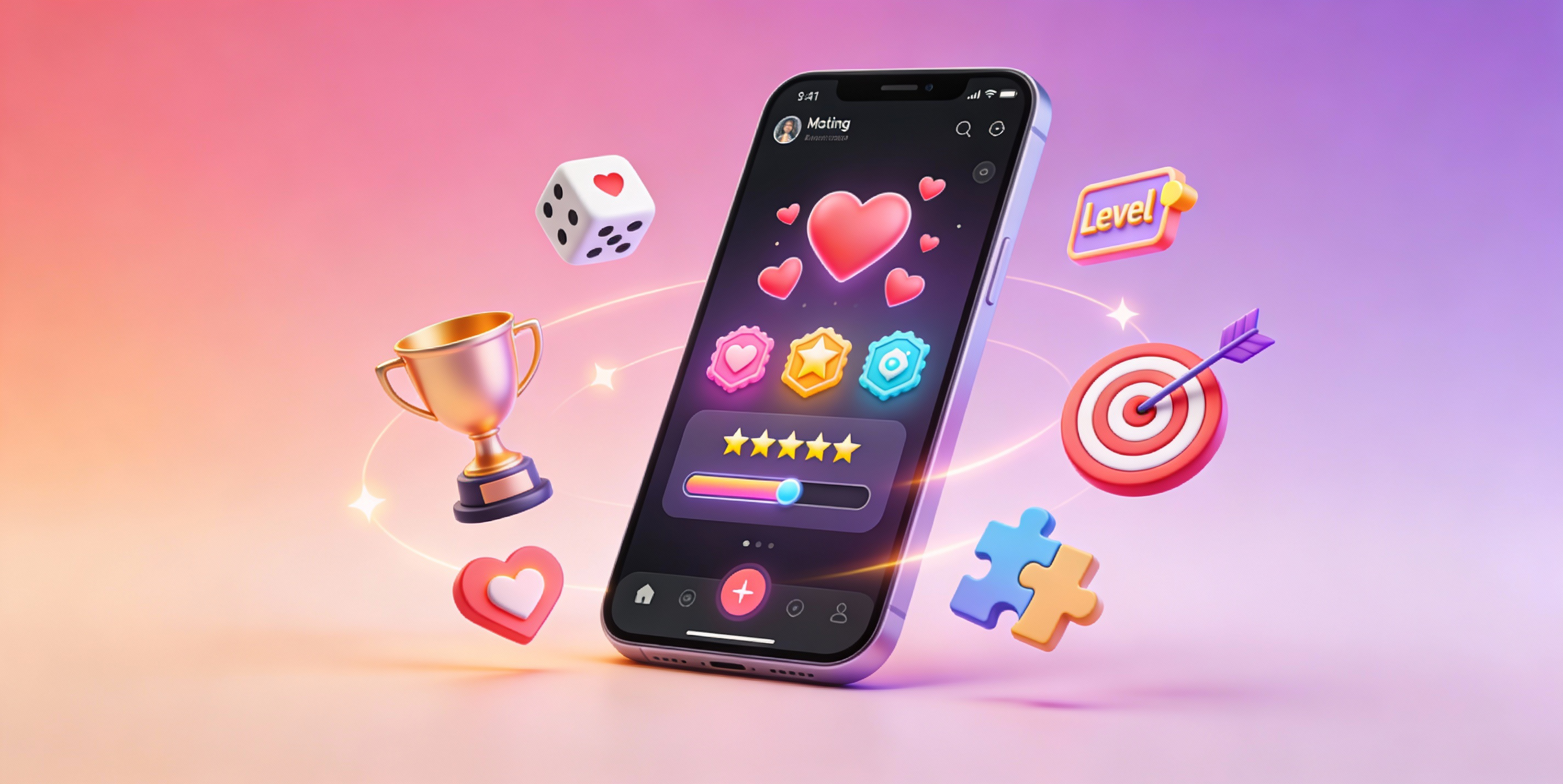
Gamification in online dating has transformed partner search from boring profile browsing into an engaging process with rewards, achievements, and instant gratification. Apps like Tinder generate one billion swipes daily, and users spend up to 10 hours per week in them. The main challenge is maintaining serious intentions while implementing game elements.
What is Gamification in Online Dating
Gamification in online dating is the application of game mechanics (points, levels, competitions) to the process of finding romantic partners. Historically, matchmaking functions were performed by dances, balls, and village games where young people looked for pairs. Modern apps have digitized this process, turning partner selection into an interactive experience.
The main task for developers is to keep users in the app as long as possible. Research shows that 39% of heterosexual relationships in the US started online in 2017. However, 34% of users never met in person with those they found in apps.
Gamification in online dating works through psychological triggers: dopamine loops, variable rewards, and reduced anxiety from rejection. Every design element—from swipes to match animations—is engineered for maximum engagement.
Psychology of Game Mechanics: Why It Works
Game mechanics in dating apps exploit the same principles as casinos or mobile games. Tinder creator Sean Rad admitted to being inspired by B.F. Skinner’s operant conditioning experiments. The anticipation of reward (matches) becomes more important than the reward itself.
The swipe mechanic creates a sense of control with minimal effort. A simple finger movement provides instant feedback without the fear of public rejection. The variable reward system—when matches appear unpredictably—triggers the same addiction mechanism as slot machines.
Positive feedback reinforces engagement. Tinder notifies users only about mutual matches—the absence of notification doesn’t mean rejection. This protects self-esteem and encourages continued play. Research confirms that 15% of users admit addiction to the process.
Core Elements of Dating Gamification
Modern dating apps use a set of proven game elements. Swipes turn choice into a quick binary decision, points and badges reward activity, quizzes personalize the experience. Each element works to retain attention.
The leveling and progression system motivates users to complete profiles more thoroughly. Hinge offers a limited number of “roses” per day, creating a sense of value for each action. Temporary boosts increase profile visibility, mimicking game “power-ups.”
Social elements add competitiveness. Bumble uses 24-hour timers to create urgency. Tinder Social allows groups of up to three people to search for pairs together. Gamification in online dating transforms a solitary experience into a group activity.
Swipes and Instant Decisions
The swipe became the symbol of gamification in online dating after Tinder’s 2012 launch. The mechanic simplifies choice to a “yes” or “no” gesture, making the process fast and addictive. In just two years, Tinder reached one billion daily swipes.
The simplicity of swiping reduces cognitive load. Research shows that men quickly adopt a “swipe everyone right” strategy, receiving only 0.6% responses from women. Women are more selective but receive 10% responses—17 times more.
Psychologically, swiping feels like playing cards or simple solitaire. Each photo is a card in a deck that needs to be sorted into piles. Tinder even limited right swipes to 100 per 12 hours to avoid “low-quality matches.”
Reward and Achievement Systems
Rewards in dating apps work on the principle of variable reinforcement. Tinder’s “It’s a Match!” screen with bright animation provides a dopamine rush, encouraging continued swiping. The unpredictability of matches enhances engagement.
Badges and statuses create a sense of progress. Bumble rewards active users with “VIBee” status, which increases retention. XOXO uses an experience point (XP) system for completing tasks, turning dating into a role-playing game.
Super Likes in Tinder work as a rare game bonus—available once daily for free. This creates value for the gesture and boosts the recipient’s confidence. Paid options (Boosts, Gold) monetize the desire to accelerate progress, like in free-to-play games.
Quizzes and Personalization
Quizzes shift focus from appearance to character compatibility. XOXO uses personality tests during registration, matching pairs by common traits. This reduces fatigue from endless profile browsing and makes the process more meaningful.
Hinge implemented prompts like “My perfect date is…” to start conversations. Users choose from ready-made questions, which simplifies profile creation and provides common ground. Such gamification in online dating improves the quality of first messages.
Hinge’s personalized “Most Compatible” recommendations use algorithms to predict successful pairs. The feeling that the system “works for you” increases trust. This is a balance between automation and personal choice.
Timers and Action Urgency
Time limitations create pressure through the fear-of-missing-out mechanic. Bumble gives women 24 hours to send the first message after matching, or the connection disappears. This stimulates quick action instead of endless match accumulation.
Artificial urgency increases engagement by 40% compared to apps without timers. Users perceive limited time as a game challenge, not an obstacle. Bumble allows one free match extension per day, monetizing anxiety through purchasing additional extensions.
Coffee Meets Bagel shows a limited number of profiles once daily at noon. Scarcity of choice increases the value of each proposal. This is the opposite of Tinder’s “infinite swipe,” targeting users seeking serious relationships.
Successful Mechanics Examples: Tinder, Bumble, Hinge
Tinder built an empire on swipe simplicity and game aesthetics. Bright match animations, Super Likes as “rare bonuses,” Boosts for temporary enhancement—everything is borrowed from mobile games. The platform generates 1.5 million dates weekly.
Bumble added a feminist angle, giving women control over the first message. This solved the problem of mass generic messages from men (averaging 12 characters versus 122 from women). 24-hour timers and activity badges retain users.
Hinge positions itself as “the app designed to be deleted.” Profile prompts, limited daily likes, “roses” for special interests—mechanics aimed at quality, not quantity. Gamification in online dating here serves serious intentions rather than entertainment.
The Main Problem: Balance Between Game and Seriousness
Excessive gamification turns people into game objects. Research shows that Tinder users perceive the app more as a game than a way to find a partner. Many “play out of boredom” rather than with the goal of meeting.
Superficial interactions are a side effect of gamification. On Tinder, less than 1 in 500 swipes leads to phone number exchange. Fast scrolling skips compatible profiles, focusing on visual attractiveness. This dehumanizes the dating process.
Balance is achieved through mechanics that encourage thoughtfulness. Hinge limits free likes to 10 per day, forcing more careful selection. XOXO uses avatars (Totems) and group chats to reduce one-on-one pressure. Gamification in online dating should enhance, not replace, human connection.
Risks of Excessive Gamification
Addiction to dopamine loops affects one in six users. Psychologists compare endless swiping to slot machines—the anticipation of reward becomes more important than the result. This leads to burnout and reduced focus on real meetings.
Algorithmic bias creates inequality. Tinder’s Elo rating system can push certain demographic groups aside. Studies show that Black women and Asian men receive fewer positive responses, creating a sense of “unfair play.”
Monetization through connection undermines trust. Tinder Select at $499 per month, paid Boosts without result guarantees—everything prioritizes profit over love. Users feel manipulated when the free version is deliberately limited to sell premium.
How to Implement Game Elements Without Losing Trust
Algorithm transparency builds trust. Explain how pair matching works, what factors affect profile visibility. Hinge publicly shares the principles of its “Most Compatible” algorithm, which increases perceived honesty.
Focus on connection quality, not quantity metrics. Avoid view counters or attractiveness ratings—they amplify anxiety. Instead, reward profile completion, answering questions, and meaningful messages.
Balance game and human elements. Coffee Meets Bagel uses internal currency (beans) but doesn’t make it the only way to progress. A slow free version is available without pressure. Gamification in online dating works better when optional, not mandatory.
Gamification for Different Dating Goals
For serious relationships, use depth mechanics: detailed compatibility quizzes, limited daily matches, mandatory text profiles. Hinge and Coffee Meets Bagel demonstrate this approach, slowing the process for thoughtfulness.
For casual dating, dynamic mechanics work: fast swipes, mass matches, minimal profile requirements. Tinder is optimized for volume and speed, which aligns with casual dating goals.
For niche audiences, add specialized filters and communities. XOXO focuses on inclusivity with expanded gender options and values-based filters. Bumble BFF uses the same mechanics for finding friends rather than romantic partners.
Metrics for Game Mechanics Effectiveness
User retention is the key gamification metric. Successful apps achieve 11 logins per day with average sessions of 7-8 minutes. Bumble retains users through VIBee badges and timers, Tinder through variable rewards.
Interaction quality is measured not by swipe count but by the percentage converting to messages. On Bumble, 21% of women message first after matching versus 7% of men in regular apps. This shows the effectiveness of the “women message first” mechanic.
Conversion to real meetings is the ultimate success indicator. Hinge measures app deletions after relationship starts. This contradicts the business model of infinite usage but builds a reputation for effectiveness. Gamification in online dating should lead to results, not replace them.
The Future of Gamification in Online Dating
AI-driven personalization will make matching more precise. Algorithms will analyze not only profiles but chat history, communication style, and activity times. XOXO already uses AI for personalized recommendations based on quizzes.
Virtual and augmented reality will create new date formats. Virtual coffee shops for long-distance couples, AR profiles with 3D avatars, metaverse for group dating—technologies will expand gamification possibilities.
Blockchain will increase trust through verified profiles. Identity verification badges will become game achievements, and decentralized data storage will protect privacy. Gamification in online dating will evolve from entertainment to security and authenticity.
Conclusion
Gamification in online dating is a powerful engagement tool that requires caution. Successful apps balance entertainment and seriousness through thoughtful mechanics: limited actions for deliberation, quizzes for compatibility, time frames for motivation. The key is remembering that game elements should help people find connections, not replace them with endless scrolling.