



The Real Dating App Development Cost: A 2026 Guide for Developers

Dating App Development Cost in 2026: From MVP to Scalable Platform
Launching a dating app in 2026 requires more than a compelling dating app idea and a development team. You need a clear understanding of how much does it cost to bring your vision to life—from a basic dating app to an enterprise-grade platform serving millions of users.
This guide is for founders, product managers, and entrepreneurs planning to launch a dating app in 2026. Understanding the full cost landscape is crucial for budgeting, investor communications, and long-term business planning.
This guide breaks down every key factor that will affect dating app development cost, helps you budget for hidden expenses, and shows how working with a specialized dating app development company like Dating Pro can reduce both time and money spent.
Dating App Development Cost in 2026: Quick Answer
In 2026, dating app development typically ranges from $15,000–$60,000 for a minimal viable product (MVP) focused on core features, and $70,000–$350,000+ for a full-scale product with advanced features, AI matchmaking, video calls, and multi-region compliance.
Costs differ significantly based on app type—swipe-based, video-first, AI-driven, or niche community—and planning for infrastructure costs, safety, and compliance is as important as adding eye-catching app features.
Key takeaways at a glance:
- Basic swipe-based MVP: $15,000–$40,000
- Mid-level app with subscriptions and moderation: $40,000–$90,000
- Advanced AI/video-heavy platform: $120,000–$350,000+
- Cross-platform development (Flutter/React Native) saves 20–35% vs. native apps
- Dating Pro’s prebuilt modules cut custom development by 20–40%
- Typical MVP launch with Dating Pro: 8–12 weeks instead of 5–6 months
Online Dating Market in 2024–2026: Why Costs Are Rising
The online dating market continues its explosive growth, with global revenue reaching approximately $9.4 billion in 2022 and projected to exceed $15–16 billion by 2030. This expansion directly fuels rising development costs as user expectations and regulatory requirements become more demanding.

In 2024–2026, dating apps are evolving into broader social discovery platforms that incorporate live streams, virtual events, and community forums. This shift from simple swipes to complex ecosystems demands intricate backend architectures for real-time moderation and content delivery networks.
How market trends influence development costs in 2026:
- User expectations now mandate seamless social login, AI-powered recommendations, video profiles, and hyper-advanced filters (lifestyle, values, pet preferences)
- Apple’s App Tracking Transparency and Google’s Privacy Sandbox require consent management systems, adding 5–10% to budgets
- GDPR in the EU, CCPA/CPRA in California, the UK’s Online Safety Act, and Australia’s age-verification rules push 10–25% of budgets into compliance-ready design from inception
- Real-time infrastructure for messaging, geolocation, and push notifications requires WebSockets and edge computing—far beyond early Tinder-like apps using simple SQL queries
- Moderation and safety systems must handle AI-driven content filtering, anti-spam heuristics, and fraud detection to avoid store rejections or regulatory fines
Because of these trends, budgeting only for “screens and features” is outdated. A successful dating app in 2026 requires investment in safety, infrastructure, and governance from day one.
Key Factors That Shape Dating App Development Cost
Dating app cost is not a single number but the sum of decisions about scope, platforms, technology stack, geography, and safety level. Understanding these key cost drivers helps you build realistic budgets and avoid costly surprises during the development process. Outsourcing QA testing and overall project management to a professional dating app development service can help ensure quality, security, and proper testing processes, potentially reducing long-term costs.
Main cost drivers for building a dating app:
- Product scope and feature depth
- UI/UX design complexity
- Trust, safety, and moderation systems
- Compliance, security, and data governance
- Scalability and infrastructure
- Platform choice (native vs. cross platform)
- Development team model and geography
- Monetization strategy and third party integrations
The following subsections drill into each major driver with 2024–2026 realities and example price corridors.
Product Scope and Feature Depth
More than any other factor, your chosen feature set and depth define the base budget. A minimal swipe-based MVP costs far less than an AI-driven platform with video feeds and virtual events.
Typical Cost Ranges by Complexity
| App Complexity | Feature Set | Estimated Cost |
|---|---|---|
| Minimal MVP | Swipe, profiles, basic chat | $15,000–$30,000 |
| Mid-level | Subscriptions, in app purchases, basic moderation | $40,000–$90,000 |
| Advanced | AI recommendations, video, events, gifts | $120,000–$350,000+ |
Essential Features
Core features that are “must-have” in 2026:
- Registration (email/phone OTP) and onboarding
- User profiles with photo uploads
- Matching algorithm (geolocation, preferences)
- Real-time chat
- Likes, super-likes, reporting/blocking
- Push notifications
- Admin panel
These essential features typically consume 500–800 developer hours at regional rates of $25–$160/hour.
Advanced Features
More advanced features that increase budget:
- AI-based recommendations and compatibility scoring
- TikTok-style video feed and stories
- In-app events and live speed dating
- Boosters, gifts, and virtual currency
- Advanced filters (lifestyle, values, detailed preferences)
Adding video profiles alone can add $8,000–$25,000 depending on quality requirements and moderation needs. Each “smart” feature also requires analytics dashboards and configuration UI on the admin side—an area founders often forget to budget for.
UI/UX Design Complexity
In a competitive dating app market dominated by Tinder, Bumble, and Hinge, polished UI UX design directly affects user retention and ROI. Users expect an intuitive user interface that feels native to their platform.
Approximate Design Cost Brackets in 2026
| Design Level | Estimated Cost |
|---|---|
| Simple template-based UI | $2,000–$5,000 |
| Custom brand design (iOS/Android) | $6,000–$18,000 |
| Complex animation-rich design | $20,000+ |
Design Cost Factors
Factors that drive design effort:
- Number of unique screens (typically 20–30 for dating apps)
- Custom illustrations and iconography
- Micro-interactions and animations (Lottie)
- Accessibility (VoiceOver, TalkBack support)
- Dark mode and localization (RTL languages)
- Interactive prototypes for user testing
Research, customer journey mapping (CJM), and interactive prototypes increase upfront time but reduce rework and development waste later. Dating Pro shortens the design phase by using a library of tested UI patterns and reusable components while still fully customizing branding and UX flows.
Trust, Safety, and Moderation Systems
In 2024–2026, safety is treated as a core system, not an optional add-on. Development costs here directly reduce legal and reputational risk, especially given that romance scams cost users an estimated $1.3 billion annually according to FTC reports.
Safety Mechanisms
Typical safety mechanisms for dating apps:
- User reporting and blocking workflows
- Content filters (keywords, image hashing)
- AI-powered image/video moderation (e.g., nudity detection via TensorFlow)
- Device, phone, and email verification
- Anti-spam heuristics and rate-limiting
- Optional KYC verification for specific markets ($1–3 per verification via Jumio or Onfido)
Manual-only moderation may suffice for up to 10,000–20,000 MAU, but beyond that, real-time automated pipelines become mandatory and can add $10,000–$60,000+ to development budgets.
Early investment in moderation tools is significantly cheaper than redesigning the system after user complaints or app store bans. Dating Pro offers prebuilt moderation dashboards and workflows that can be tailored to client needs, cutting implementation time for safety features.
Compliance, Security, and Data Governance
Dating apps handle highly sensitive user data—photos, location, sexual orientation, preferences, and payments—making security and privacy non-negotiable budget items for any dating platform.
| Regulation | Region | Key Requirements |
|---|---|---|
| GDPR | EU | Consent screens, data export/delete, DPIAs |
| CCPA/CPRA | California | Opt-out mechanisms, data sales disclosure |
| Online Safety Act | UK | Age verification via biometrics or ID |
| Privacy laws | Australia | KYC integrations, verification requirements |
Security Tasks
Typical security tasks that affect app development cost:
- Encrypted communication (TLS 1.3)
- Secure password storage (bcrypt/Argon2)
- Role-based access control and audit logging
- Penetration testing ($5,000–$15,000 via specialized firms)
- Incident response planning and documentation
Budget allocation: 10–25% of initial development cost should be planned for security and compliance work. Cross region compliance management adds complexity when launching in multiple jurisdictions simultaneously.
Dating Pro follows security-by-design principles and has reusable patterns and checklists, reducing the risk of expensive redesigns and third-party audits later. For a deeper look at the Dating Pro team and platform, you can review how we structure products, processes, and long-term support. Local data residency requirements may require additional architecture planning.
Scalability and Infrastructure
Early-stage apps might support thousands of users, but if your goal is to reach hundreds of thousands or millions, architecture decisions must anticipate scale from the start.
Infrastructure cost considerations:
- MVP can often use modest cloud services (Heroku, DigitalOcean) at $100–500/month
- Video-heavy or global platforms require Kubernetes clusters on AWS/GCP, costing thousands monthly
- WebSockets for real-time messaging require Redis pub/sub at scale
- Live video streaming via Agora/Twilio adds approximately $0.004/minute
- ML recommendations require GPU instances for training
Investing in horizontal scalability, load balancing, and proper database sharding upfront is cheaper than a full re-architecture 12–18 months later. Dating Pro uses scale-tested backend development modules and cloud infrastructure best practices, similar to our open source dating software platform, allowing clients to start lean but scale without rewriting core systems.
Development Team Composition and Geography
Hourly rates in 2026 vary heavily by region, significantly affecting how much does it cost to build your app:
| Region | Hourly Rate |
|---|---|
| Eastern Europe/India | $25–$45 |
| Central Europe | $40–$80 |
| US/UK/Australia | $80–$160+ |
| Typical team for developing a dating app: |
- Product manager (10% time)
- UI/UX designer
- 1–2 mobile developers
- Backend developer (Node.js, Python)
- QA engineer
- DevOps specialist
- AI/ML engineer (for advanced features)
A 3–6 month build might cost $50,000 with an offshore team versus $200,000+ with a US agency. Dating Pro offers a full-cycle cross-functional development team with established processes, reducing coordination overhead and the risk of underestimating hidden work like analytics and admin tools, and can provide comprehensive white-label dating site and app solutions when you need to launch across web and mobile.
How Platform Choice Influences Dating App Development Cost
In 2026, most dating apps launch with cross platform frameworks (Flutter or React Native) or separate native apps (Swift/Kotlin), sometimes combined with a web app.
| Approach | Upfront Cost | Time-to-Market | Best For |
|---|---|---|---|
| Cross platform (Flutter/React Native) | 20–35% lower | Faster | MVP validation, budget-conscious |
| Native apps | Higher | Longer | Performance-critical, AR/video |
| PWA (web-first) | $35K–$90K | Fast | Initial validation |
| Native development is the process of creating apps specifically tailored for either iOS or Android, which involves higher initial costs but allows for optimized performance and better access to device features. The choice between native and cross-platform development affects both initial costs and long-term scalability. Developing natively for iOS and Android rather than cross-platform can increase costs by 15-30%. Cross platform apps share 80% of code between iOS and Android, but demanding real-time or heavy video features might require native optimization later. Platform choice also affects long-term maintenance: each supported platform means more QA, release management, and OS-specific fixes. |
Dating Pro often recommends cross-platform for first release to validate market demand, then selectively adding native modules if analytics show the need, leveraging our tools to build mobile dating apps without coding skills when speed and cost-efficiency are the priority.
Monetization Models and Their Cost Impact
Revenue strategy fundamentally shapes backend development logic, data flows, and third party services—all of which carry development and compliance costs.
Subscription and freemium models (like Tinder Plus/Gold) require:
- Robust billing integrations (Apple, Google, Stripe)
- Entitlement logic for feature gating
- Subscription management and renewal handling
In app purchases and virtual currency require:
- Anti-fraud protections and tokenization
- Purchase history and refund flows
- Virtual economy balance management
Advertising-based models require:
- Ad network integration (AdMob)
- Consent management for GDPR/ATT compliance
- Performance optimization to maintain user engagement
Dating Pro has ready-made modules for subscription management, paywalls, and in-app purchases, similar to those in our award-winning dating software script, helping clients test monetization without reinventing the wheel. Adding boosts, super-likes, or paid profile highlights typically adds $1,000–$4,500 in backend work.
Where the Dating App Budget Actually Goes
Many founders underestimate “invisible” areas like backend, moderation, admin tools, analytics, and comprehensive testing, which collectively consume a large slice of budget.
Approximate budget distribution for a mid-complexity app:
- Backend and infrastructure: 35–45%
- Mobile/web clients: 20–30%
- Design and product: 10–20%
- QA and testing: 10–15%
- Trust/safety and compliance: 10–20%
Admin dashboards (user management, reports, content review, metrics) may take 15–25% of total development effort if built from scratch. Dating Pro reduces this admin burden significantly with ready-made admin panels, analytics hooks, and moderation tools that users generate data through.
How Development Timelines Affect Dating App Cost
Typical timelines in 2026 vary based on scope:
- Focused MVP: 2–3 months ($20K–$40K)
- Feature-rich app: 4–7 months ($60K–$150K)
- Enterprise grade platforms: 9–18+ months ($180K+)
Compressing timelines (“we want it in 6 weeks”) usually increases cost via parallelization, overtime, and larger teams—often adding 20–50% to the budget.
Benefits of phased delivery:
- Phase 1: MVP with core features
- Phase 2: Monetization and advanced features
- Phase 3: Scaling and optimization
This approach spreads costs and reduces risk. Dating Pro typically recommends launching a lean, revenue-capable MVP in 8–12 weeks, then iterating based on user feedback and real data. Adding or cutting 4–6 weeks from a schedule can shift the budget by $15,000–$30,000.
Types of Dating Apps and Their Cost Profiles
There are three main types of dating apps: geolocation-based, questionnaire-based, and niche apps. Geolocation-based dating apps allow users to find matches in their immediate area. Questionnaire-based dating apps use user responses to match individuals based on compatibility. Niche dating apps cater to specific groups of users with shared interests or demographics.
Not all online dating apps are equal in cost. App type dictates both features and required infrastructure, creating distinct enterprise grade cost profiles.
Main types and relative cost levels:
- Classic swipe-based apps: Lower cost
- Questionnaire/compatibility-based apps: Medium cost
- Niche community apps: Medium cost
- Video-first platforms: Higher cost
- AI-driven matchmaking apps: Highest cost
AI-led and video-first formats have the highest ongoing operational costs due to model training, streaming infra, and heavier moderation expectations influence budgets.
Swipe-Based and Geolocation Dating Apps
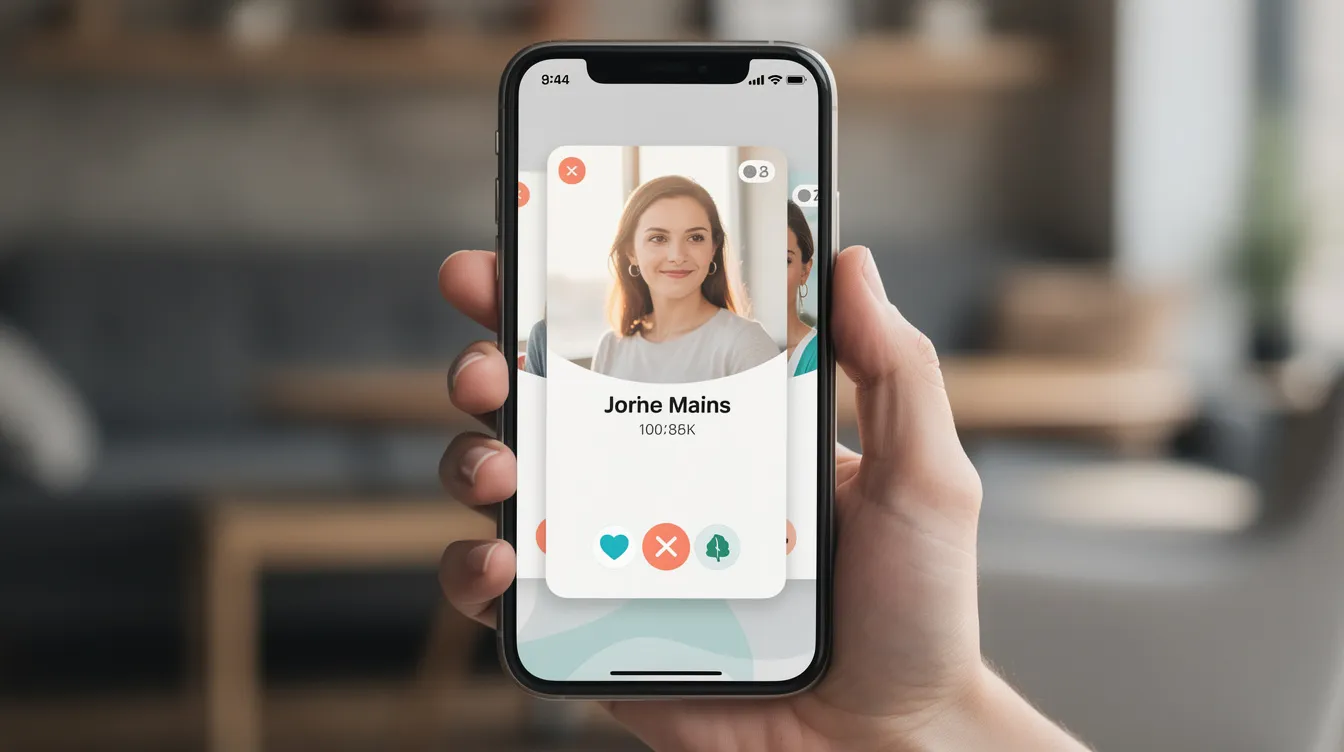
This is the most familiar model, popularized by Tinder-style swipe UX and location-based matching via Google Maps or similar APIs.
Core feature set:
- Swipe cards with mutual likes
- Matches list and chat
- Boosts and super-likes
- Radius and age filters
2026 cost range: $15,000–$40,000 for an MVP; $50,000–$120,000+ for a mature swipe app with monetization and safety systems.
Dating Pro offers prebuilt swipe modules and geolocation components, allowing such apps to launch faster and cheaper than fully custom builds targeting the same target audience.
Questionnaire and Compatibility-Based Dating Apps
This category uses detailed questionnaires, personality tests, or preference matrices to match users—inspired by OkCupid and Hinge’s prompts that keep users engaged.
Extra cost centers:
- Survey builder and progressive profiling
- Scoring engine (e.g., Big Five personality matrices)
- “Why this match” explanation UI
- Complex onboarding flows
Estimated range: Typically +20–40% over a comparable swipe-based MVP, depending on matching logic sophistication.
Dating Pro can integrate existing matching engines and configurable questionnaires to avoid implementing every rule from scratch, balancing cost with the deeper perceived value users seek.
Niche Community and Interest-Based Dating Apps
Niche apps focus on specific groups—profession, religion, hobbies, lifestyle—often requiring specialized onboarding and community features.
Key considerations:
- More effort in branding and safety policies
- Community management tools (groups, forums, events)
- Private communities or event booking features
- Targeted moderation for sensitive topics
Cost can be similar to or slightly above a swipe-based app, with strong variation depending on features. Dating Pro’s modular architecture is well-suited to quickly re-therming and extending core features for niche verticals, including adult dating software solutions, saving budget for experimentation.
Video-First and Live-Streaming Dating Apps
Apps built around video profiles, live streams, and real-time speed dating require specialized infrastructure and stronger moderation.
Cost impacts:
- High-quality video profiles and video calls: +$20,000–$60,000
- Full live-streaming ecosystems: $150,000–$300,000+ even for early versions
- Ongoing costs: bandwidth, storage, transcoding, human moderators
Dating Pro supports integration with established video APIs and advises on phasing in video features to manage budget effectively.
AI-Driven and Recommendation-Heavy Dating Apps
These apps rely on ML models for recommendations, profile scoring, anomaly detection, and personalized feeds—an emerging trend with significant enterprise cost impact.
Cost considerations:
- Initial implementation plus ongoing model training
- Data annotation ($0.10/sample)
- A/B testing infrastructure
- Compliance with AI regulations (EU AI Act)
Approximate uplift: AI-heavy features can add $30,000–$100,000+ to initial budgets.
Dating Pro offers pragmatic, cost-conscious AI options: starting with rule-based and lightweight ML approaches, then evolving to more complex models once user behavior data justifies investment.
Geography and Its Impact on Dating App Development Cost
Both development-team location and target-market regulations shape total cost to build and operate.
Geographic considerations:
- Teams in Eastern Europe or India can reduce engineering spend by 50–70%
- Launching in US, EU, UK, or Australia requires additional privacy and age verification investment
- Cross region compliance management adds $5,000–$15,000+ per country
Dating Pro works with clients targeting multiple geographies and can architect region-aware deployments with separate data storage and localized policies to balance cost and compliance.
Build vs. Customize vs. White-Label: Cost Implications
Three main approaches exist for dating app platforms:
| Approach | Flexibility | Cost | Time |
|---|---|---|---|
| Fully custom | Maximum | $150K–$400K+ | 9–12 months |
| White-label | Limited | $30K–$80K | 4–8 weeks |
| Hybrid | Optimal | $60K–$140K | 8–12 weeks |
| Dating Pro operates in the hybrid/white-label-friendly space, which is a strong option when you’re deciding which dating platform model to choose. We bring tested dating engines, admin panels, and UI kits, then customize around the client’s brand and unique features. | |||
| A purely custom mid-level competitive dating app in North America might reach $150,000–$250,000+, whereas leveraging Dating Pro’s platform can bring that down to $60,000–$140,000 depending on customization depth. |
Hidden and Ongoing Costs of Running a Dating App
The build phase is often only 30–50% of the 3-year cost. Operations, marketing, user support, moderation, and continuous development make up the rest.
Cloud Services
Typical ongoing cost items:
- Cloud services and CDNs: $500–$10,000/month scaling with MAU
- Third party services (SMS, email, analytics): variable
- App store fees: 15–30% revenue share
Moderation and Support
- Moderation team: $2,000–$20,000/month
- Customer support: $50/agent/month (Zendesk)
User Acquisition Costs
- User acquisition: $1–5/install (Facebook Ads)
- Feature updates: 15–25% of initial build budget per year
Monitoring KPIs (20–30% DAU/MAU, <5% churn, $10–20 ARPU) ensures development spend aligns with revenue and growth goals. Dating Pro offers long-term support and iterative development packages, including our Dating Pro x10 scaling plan, helping clients plan predictable monthly budgets for mobile app development and scalable architecture maintenance.
Enterprise Cost Impact
When building a dating app at the enterprise level, the cost impact extends far beyond initial development. Enterprises entering the online dating market must be prepared for significant investment across multiple dimensions—technology, infrastructure, and ongoing operations. The development costs for a successful dating app can range from $40,000 for a basic platform to $400,000 or more for a feature-rich, scalable solution.
Key drivers of enterprise cost include the choice of technology stack, the size and expertise of the development team, and the integration of advanced features such as AI-powered matchmaking, video calls, and in app purchases. These features not only enhance user experience but also require robust backend development and cloud infrastructure to ensure reliability and scalability.
Ongoing infrastructure costs are another major consideration. As your user base grows, so do expenses related to cloud services, data storage, and bandwidth—especially if your app supports video calls or real-time interactions. Additionally, enterprises must invest in comprehensive user support systems to maintain high satisfaction and trust, which can involve dedicated support teams and advanced moderation tools.
Maintenance and continuous development are essential for staying competitive in the fast-evolving online dating market. Regular updates, security enhancements, and the rollout of new features all contribute to the total cost of ownership. Enterprises should approach dating app development with a clear business plan that accounts for these ongoing expenses and outlines a path to revenue generation and ROI, whether through subscriptions, in app purchases, or premium features.
Enterprises measure ROI through user acquisition cost, retention rates, subscription conversion, and lifetime value growth. A positive ROI usually emerges when platforms achieve stable engagement and recurring revenue without increasing operational risk.
User Engagement and Retention
User engagement and retention are at the heart of any successful dating app. Developing a dating app that keeps users engaged requires more than just attractive design—it demands a deep understanding of your target audience and a commitment to delivering a seamless, enjoyable experience.
A well-crafted user interface and intuitive navigation are essential for making a strong first impression and encouraging users to explore the app. Features like easy profile creation, personalized matching algorithms, and secure, real-time messaging help users feel comfortable and invested in the platform. The more users feel that the app understands and responds to their needs, the more likely they are to stay active and engaged.
Dating app developers should also prioritize gathering and acting on user feedback. Regularly updating the app based on user suggestions and behavior analytics ensures that the platform evolves alongside its audience. This iterative approach not only improves user satisfaction but also helps identify and address pain points before they lead to churn.
Ultimately, focusing on user engagement and retention increases the lifetime value of each user and boosts the app’s reputation in a crowded market. By continuously refining features and responding to user needs, developers can build a loyal community and drive long-term growth for their dating app.
Third Party Services and Integrations
Integrating third party services is a powerful way to enhance the functionality and user experience of a dating app. By leveraging established APIs and platforms, dating app developers can add features that would be costly or time-consuming to build from scratch.
For example, integrating Google Maps enables location-based matching and event discovery, while social media logins streamline onboarding and increase user trust. Payment gateways facilitate secure in app purchases and subscriptions, and analytics tools provide valuable insights into user behavior, helping developers optimize features and marketing strategies.
However, incorporating third party services also introduces additional complexity. Each integration must be carefully evaluated for security, reliability, and compliance with data protection regulations. Developers need to ensure that user data is handled securely and that all third party services align with the app’s privacy policies and operational standards.
By thoughtfully selecting and implementing third party integrations, dating app developers can accelerate development, enrich the user experience, and gain a competitive edge—while maintaining control over security and compliance in the ever-evolving online dating landscape.
How Dating Pro Optimizes Dating App Development Costs and Time-to-Market
We are a team focused specifically on dating and social discovery platforms, with our own reusable codebase and mobile app architecture patterns developed over years of specialization.

Concrete advantages of working with Dating Pro:
- Prebuilt modules for user profiles, matching, messaging, subscriptions, moderation tools, and analytics integrations
- Ready-made admin panels that don’t need to be built from scratch
- Tested payment integrations and security systems for handling sensitive user data
- Cross-platform delivery (web, iOS, Android) reusing the same business logic
Thanks to our own developments, we typically reduce custom feature development by 20–40%, bring MVP launch down to 8–12 weeks, and simplify future scaling. We help choose cost-effective technology stack options, optimize cloud spending through smart infrastructure pricing decisions, and design monetization so the app starts earning as early as possible.
Our dating app developers understand the unique challenges of this market—from key development phases to keeping users engaged with new features.
Typical Budget Scenarios for Dating App Development in 2026
Readers often need concrete scenarios to calibrate expectations and communicate with stakeholders or investors.
Scenario 1: Lean MVP ($20,000–$40,000)
- Single region launch (e.g., US or EU)
- Basic swipe + chat + subscriptions
- Cross-platform (Flutter)
- Timeline: 8–10 weeks
- Team: 3–4 people
- Dating Pro advantage: Prebuilt matching and chat modules cut 4–6 weeks
Scenario 2: Growth-Ready App ($60,000–$150,000)
- Advanced filters and basic AI recommendations
- Moderation tools and safety systems
- iOS + Android clients with custom branding
- Phase estimated cost planning across 2–3 releases
- Timeline: 4–6 months
- Dating Pro advantage: Ready admin panels and analytics save 20–30%
Scenario 3: Video/AI-Heavy Platform ($180,000–$350,000+)
- Multiple countries with compliance requirements
- Live video, AI matchmaking, virtual events
- Significant infrastructure and moderation investment
- Timeline: 9–12+ months
- Dating Pro advantage: Scalable architecture from day one, phased rollout support
Conclusion: Planning Your Dating App Budget with Dating Pro
In 2026, dating app development cost ranges widely based on scope and ambition—from $15,000 MVPs to $350,000+ enterprise platforms. Smart planning around features, safety, compliance, and platform choice keeps budgets under control.
Founders should think beyond “build price” to long-term total cost of ownership: operational costs, marketing, compliance updates, and continuous product improvement. The competitive dating app market rewards those who launch fast, learn from user feedback, and iterate quickly.
Working with a specialized partner like Dating Pro—which already has core dating functionality, admin, and safety modules, plus ready-made Tinder-like mobile app templates—can dramatically lower both cost and time-to-market versus building everything from zero. Our ready-made components, experienced development team, and focus on dating app involves every critical element you need.
Ready to turn your dating app idea into reality? Contact Dating Pro for a detailed estimate based on your feature list, region, and timeline. We’ll help you prioritize features for an MVP that fits your specific budget and positions you for growth in the competitive dating app market.