

White-Label AI Companion Platform — Built For Your Brand
Your users create a companion, name her, and talk to her. She remembers them. She sends photos, voice notes and video when they unlock her. Everything runs on your domain, your branding, your payment account.
This is a white label ai companion platform: the product is finished, the brand on it is yours. Underneath it is a dating platform that has been running real sites with real paying members for years — not a demo built last month.
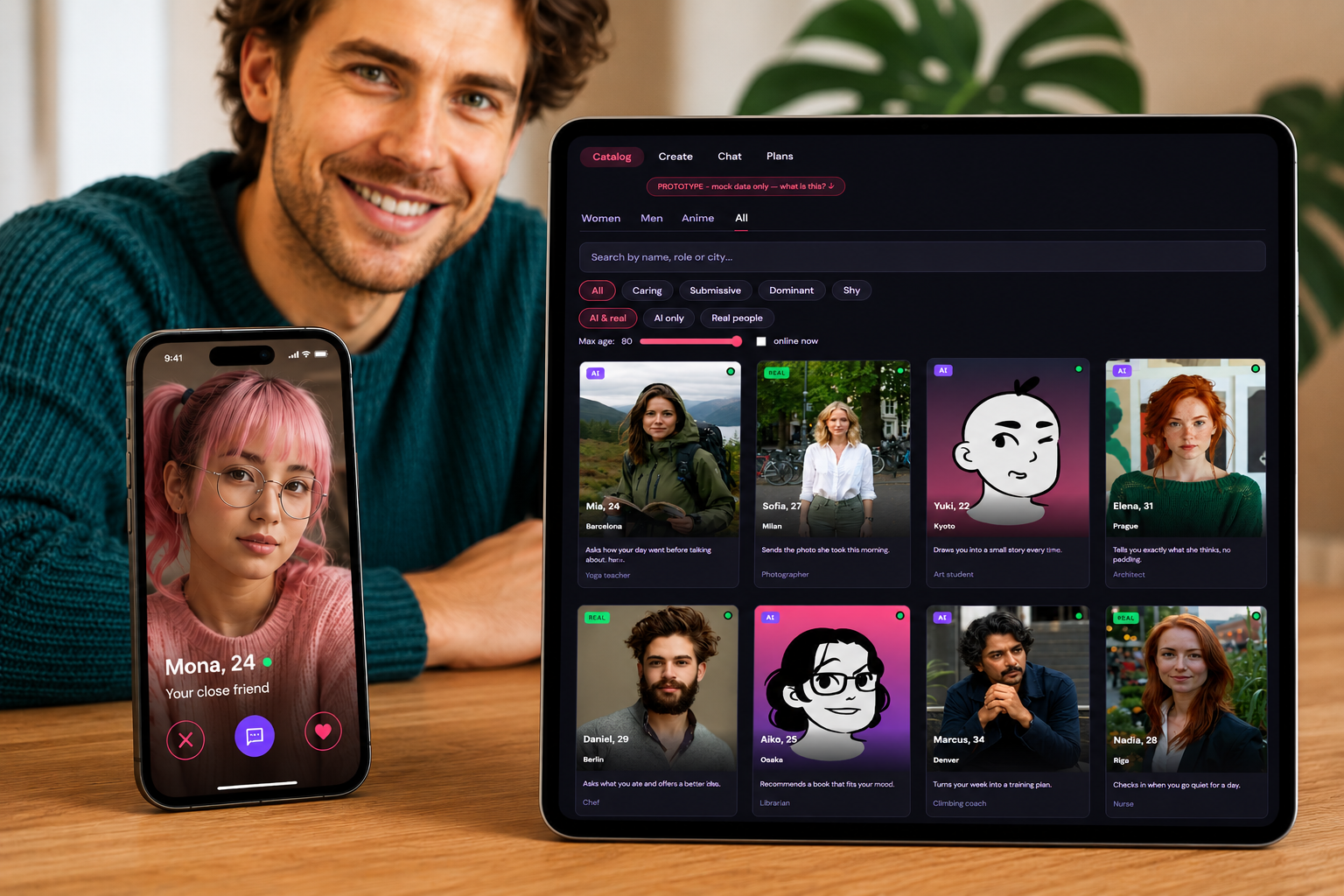
A form that ends at the product, not at a salesperson
Most pages in this category put a salesperson between you and the product. A form. A phone number. A booked call. Thirty minutes with an expert, at a time that suits them.
We checked the five pages that rank alongside this one on 31 July 2026. Not one of them lets you open the thing and click it. One of them promises "a working demo before you commit a dollar" — and then asks you to schedule a call to see it.
Our form is a form. We are not going to pretend otherwise.
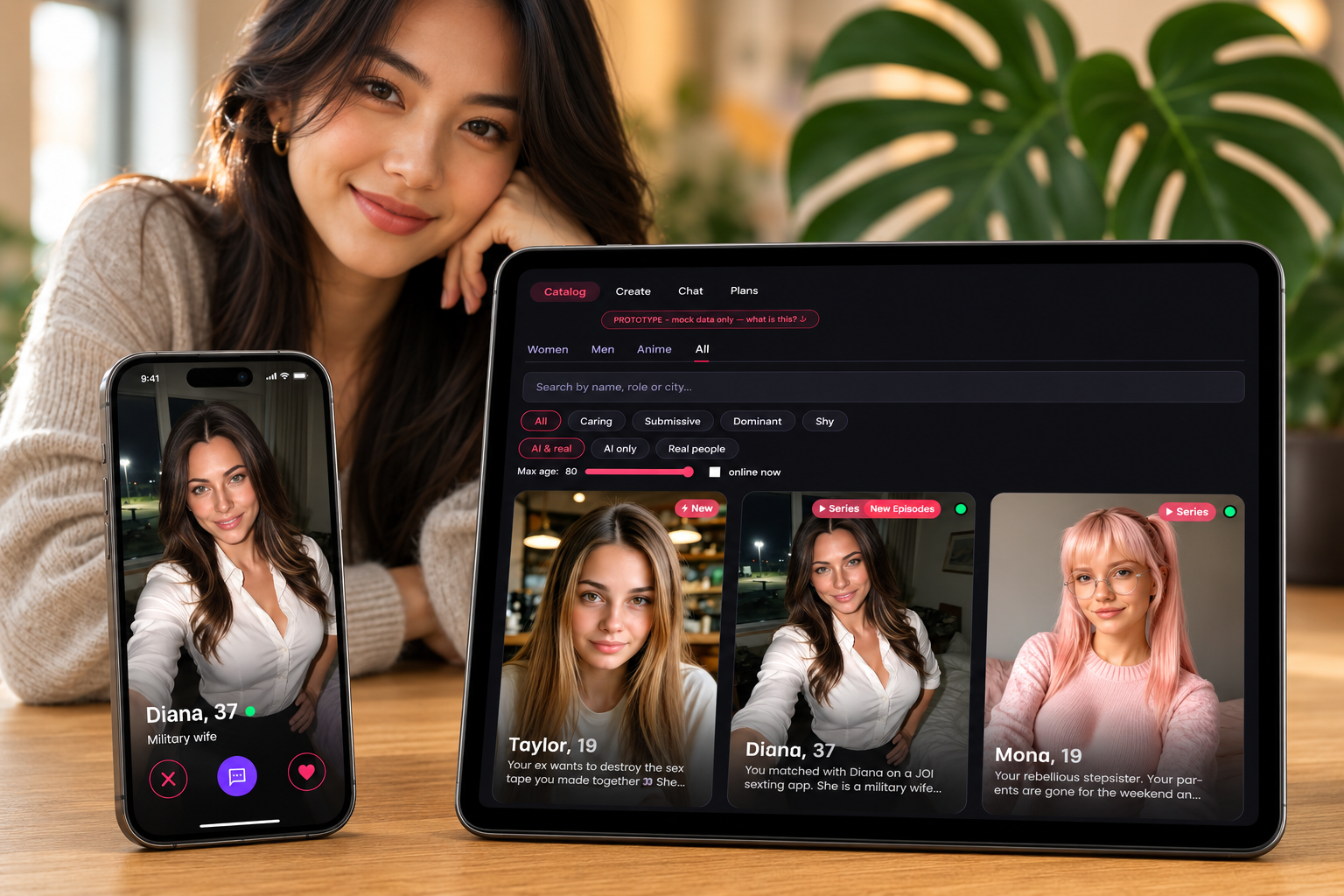
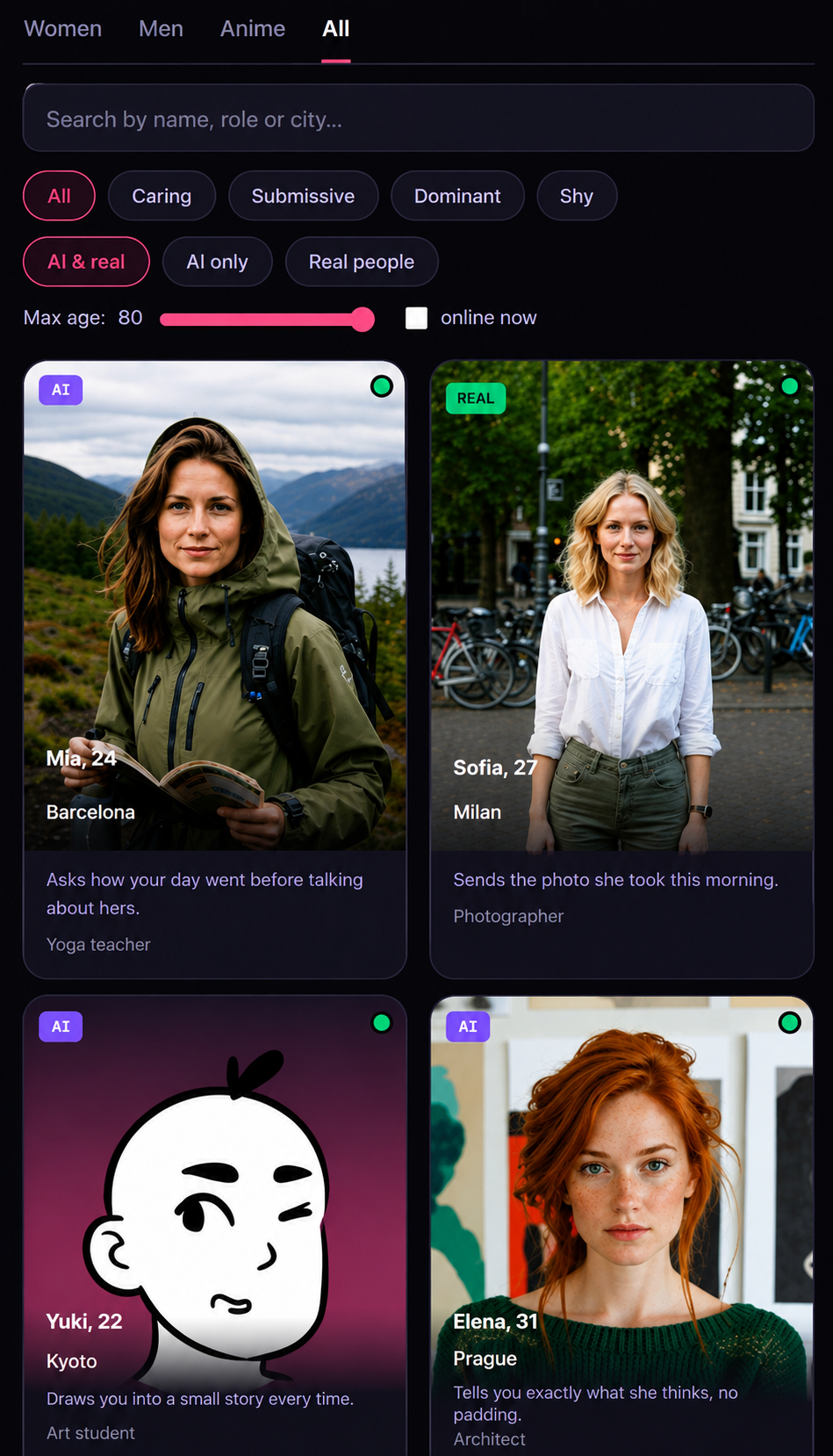
But at the end of it there is a link, and behind that link there is a working storefront: a catalogue of companions, a character profile, a chat, a token counter, locked photos and voice notes with buttons that actually unlock them.
Open the working storefront — free →
No call. No meeting. The product. The last screen of the form hands you the link. You do not wait for anyone to get back to you.
Your email goes to us and stops there. You will not be added to a mailing list about dating site licences, because that is not what you came here for.
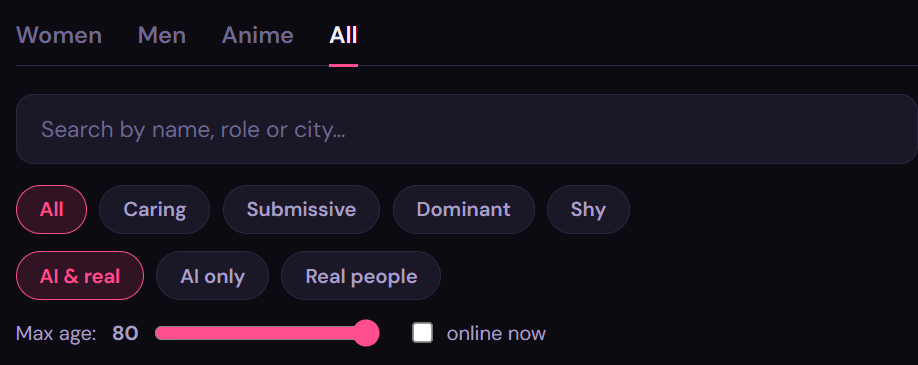
What you can do in there, in about ninety seconds:
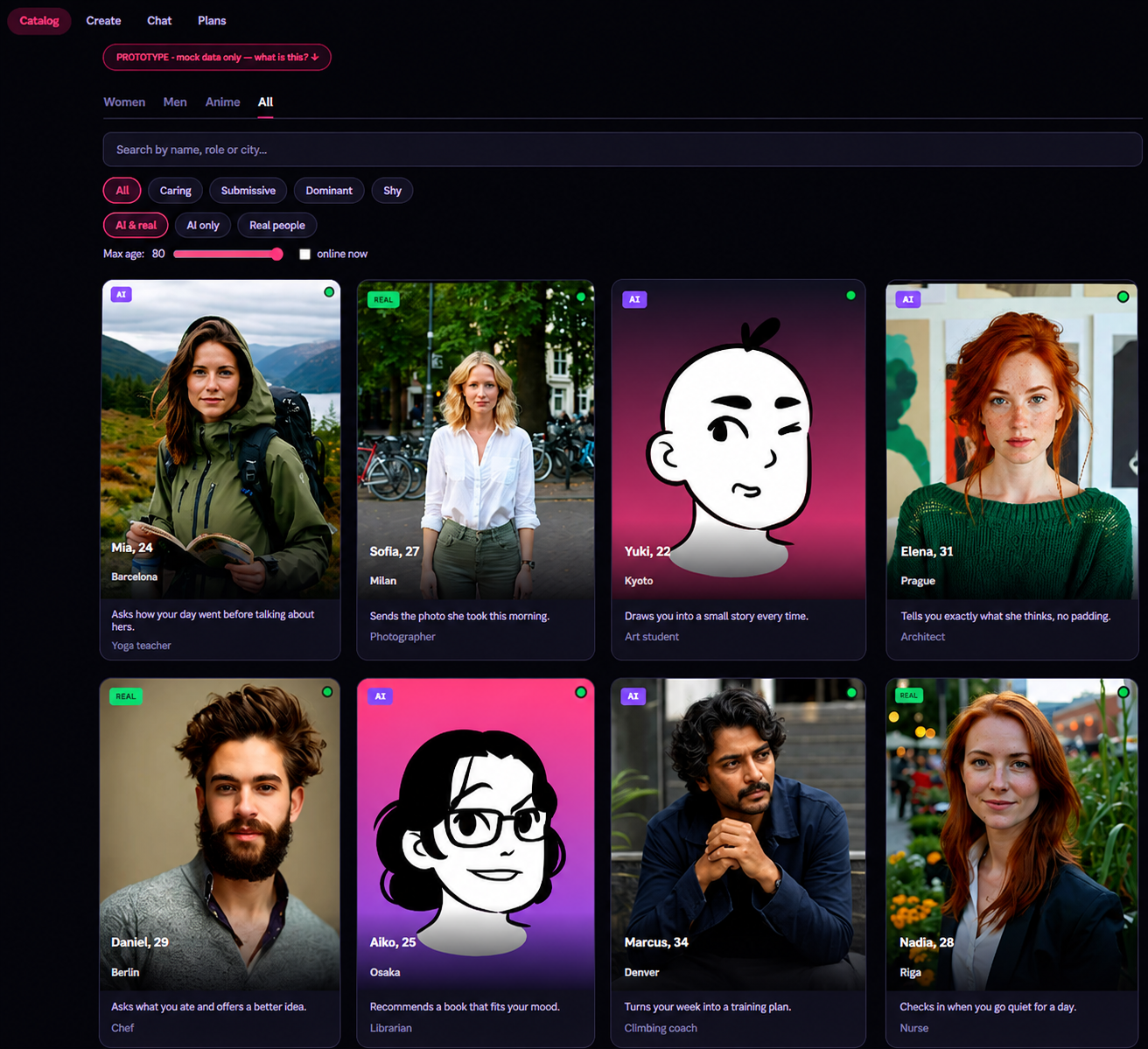
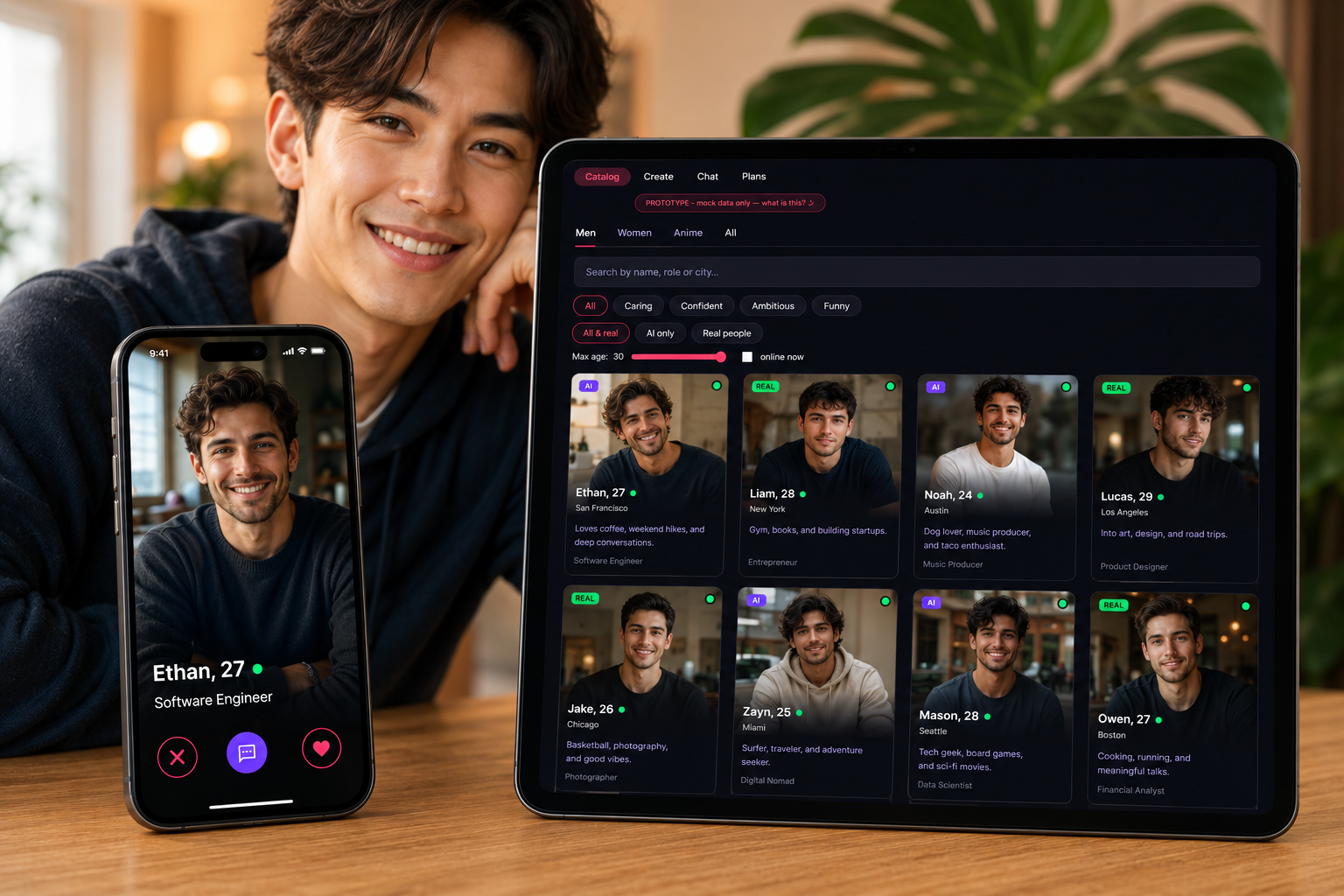
Browse a catalogue of companions and filter them the way a real user would — women, men, anime, personality, age, who is online. Open a profile. Start a chat and watch the locked photo, voice note and video sit there behind a token price. Unlock one and watch the balance drop. Go to the create screen, build a companion from scratch, name her, and see the card assemble as you choose.
Two honest notes before you click.
It runs on made-up data. The people and conversations in there are placeholders, not a live user base.
The image and voice generation buttons are labelled as what they are. When something is a placeholder, the screen says so. That rule applies to this page too.
What your users actually do inside
This is the part most vendors skip, because it is easier to list features than to describe an evening.
They create her
The create screen is a set of choices: style, look, build, hair, outfit, personality, relationship, occupation, voice. As the user picks, the avatar card assembles in front of them. Then they give her a name.
The name is the moment. Up to that point the user is filling in a form. After the name, they have made something. Everything downstream — the chat, the unlocks, the return visit tomorrow — runs on that.
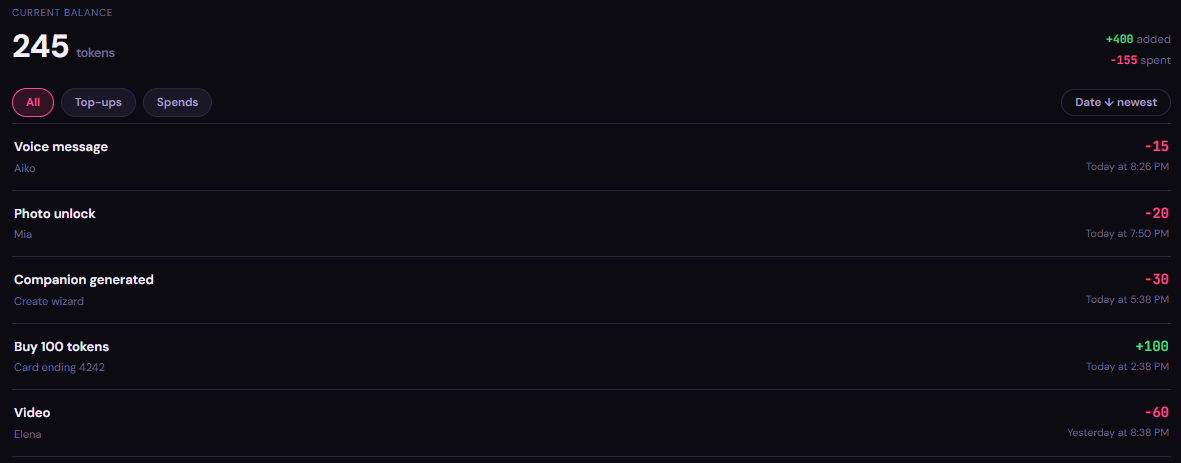
Generation costs tokens, and the button says so before it is pressed. You can walk through this exact screen in the storefront. That single line teaches the whole economy of the product in one click: things here cost tokens, tokens cost money, and here is the wallet.
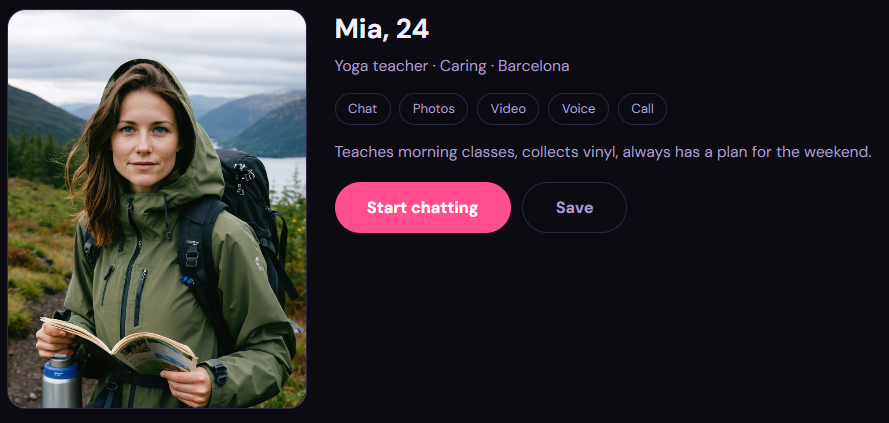
They talk, and she remembers
The chat is a chat. What makes it a companion rather than a chatbot is memory: she knows what the user told her yesterday, keeps the personality that was chosen for her, and refers back to things without being reminded.
Memory is also what brings people back. A chatbot that forgets is a toy someone tries once. A companion that remembers is a reason to open the app on the way home.
They unlock things
Photos, voice notes, videos and calls sit in the conversation behind a token price the user can see. Nothing is hidden and nothing is a surprise charge. In the prototype the prices are: photo 20 tokens, voice note 15, video 60, call 5 per minute.
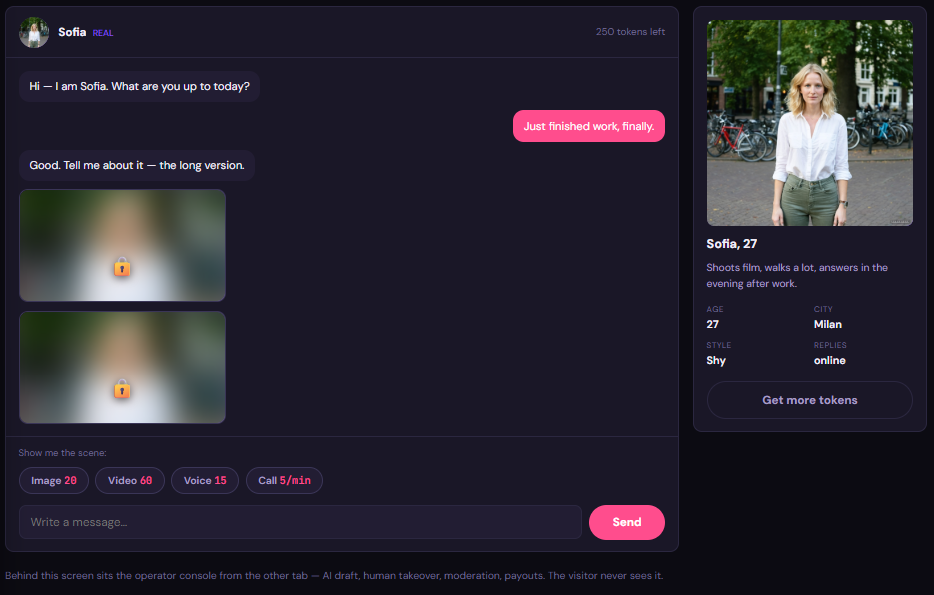
This is a deliberate design choice worth understanding. A pure subscription gives you a flat ceiling per user per month. Locked media inside a conversation lets an engaged user spend well past that ceiling, at a moment when they want to, without ever feeling billed. The wallet is topped up once; the spending feels like unlocking, not paying.
They can be in a room with more than one companion
Group conversations — several companions, or companions and real people together, in one thread — are built to order. The chat today is one user and one companion. If your product idea needs three people in a room, that is built for you and quoted as part of the build. What it is worth depends on your concept; some brands never use it, some build their whole positioning on it.
What a white-label AI companion platform is (and how it compares to a Candy AI clone)
A white-label platform is a finished product that carries your name instead of ours. Same idea as a supermarket's own-brand pasta: one factory makes it, twenty brands sell it, and the shopper only ever sees the brand on the box.
If you have been searching for white label ai chatbot software, this is that — with a face, a memory and a wallet attached, sold as a product rather than as a widget. Some people call the same thing an ai girlfriend saas. The words differ; the thing does not.
Applied here, that means: the chat engine, the profiles, the subscription billing, the moderation tools, the operator system and the admin panel already exist. What changes is the domain, the logo, the colours, the copy, the pricing, and the payment account the money lands in. Your users never see the word "Dating Pro" anywhere.
How this differs from a Candy AI clone
Search for candy ai clone and you will find a dozen agencies offering to rebuild Candy.ai for you from zero. That is a legitimate thing to buy, and if you are starting from nothing, it may be the right thing to buy.
We are offering something different, and the difference matters for what you pay and what you get.
The same shops also sell a candy ai clone script — a package of code you install yourself. That is a third thing again, and the difference is who fixes it at two in the morning.
A clone build starts with an empty folder. Someone writes the sign-up, the profiles, the chat, the payments, the complaints queue, the admin dashboard, the phone apps — all of it — and then wires an AI model into the chat. Quoted timelines in this market run from three weeks to two months. What you receive at the end has never had a user on it.
We start from a dating platform that already has all of that, running on live sites with paying members, and we add the companion layer on top. The parts that take longest to build and longest to fix — billing, moderation, phone apps, admin, scale — are not new code. They are the part that already works.
The trade-off, stated plainly: a from-scratch clone can be shaped exactly how you imagine it, with no inherited decisions. Ours comes with a structure that was designed for dating first and companions second. If your vision needs something the base platform does not do, we build it — but you are paying for extra work at that point, and we will say so rather than pretending it is included.
White label AI girlfriend, AI boyfriend, or something else entirely
The same platform runs a white label AI girlfriend product, an AI boyfriend product, an anime-character product, a non-romantic companion, or a mix of all of them in one catalogue. The character types are content and settings, not separate builds. You decide what your brand is; the engine does not care.
Looking for a Candy AI alternative you can run yourself?
A lot of people who read this page are not agencies. They are users. They have spent real money inside one of these apps, they know exactly what annoys them about it, and at some point the thought arrives: I could do this better.
If that is you, the honest answer is that there is nothing to stop you, and the gap between wanting it and having it is smaller than you think. You do not need to write chat software. You need a brand, an idea of who you are selling to, and a platform underneath. This is the platform underneath.
What changes for you compared with using an app: you set the prices, you keep the revenue minus your costs, you decide what the characters are like, and you own the users. What does not change: you still have to bring people in, and nobody can do that part for you.
AI characters and real people, side by side
Here is the thing neither side of this market currently does.
An AI companion product has one structural weakness: the user knows. However good the writing is, some part of them knows there is no one there. That knowledge caps what they will pay and how long they stay.
A dating product has the opposite weakness: there are real people, but nobody answers. A new user signs up, sends fifteen messages, gets zero replies, and leaves in a week. Every dating site operator knows this number and it is the reason most of them churn.
Put both on one platform and each one fixes the other.
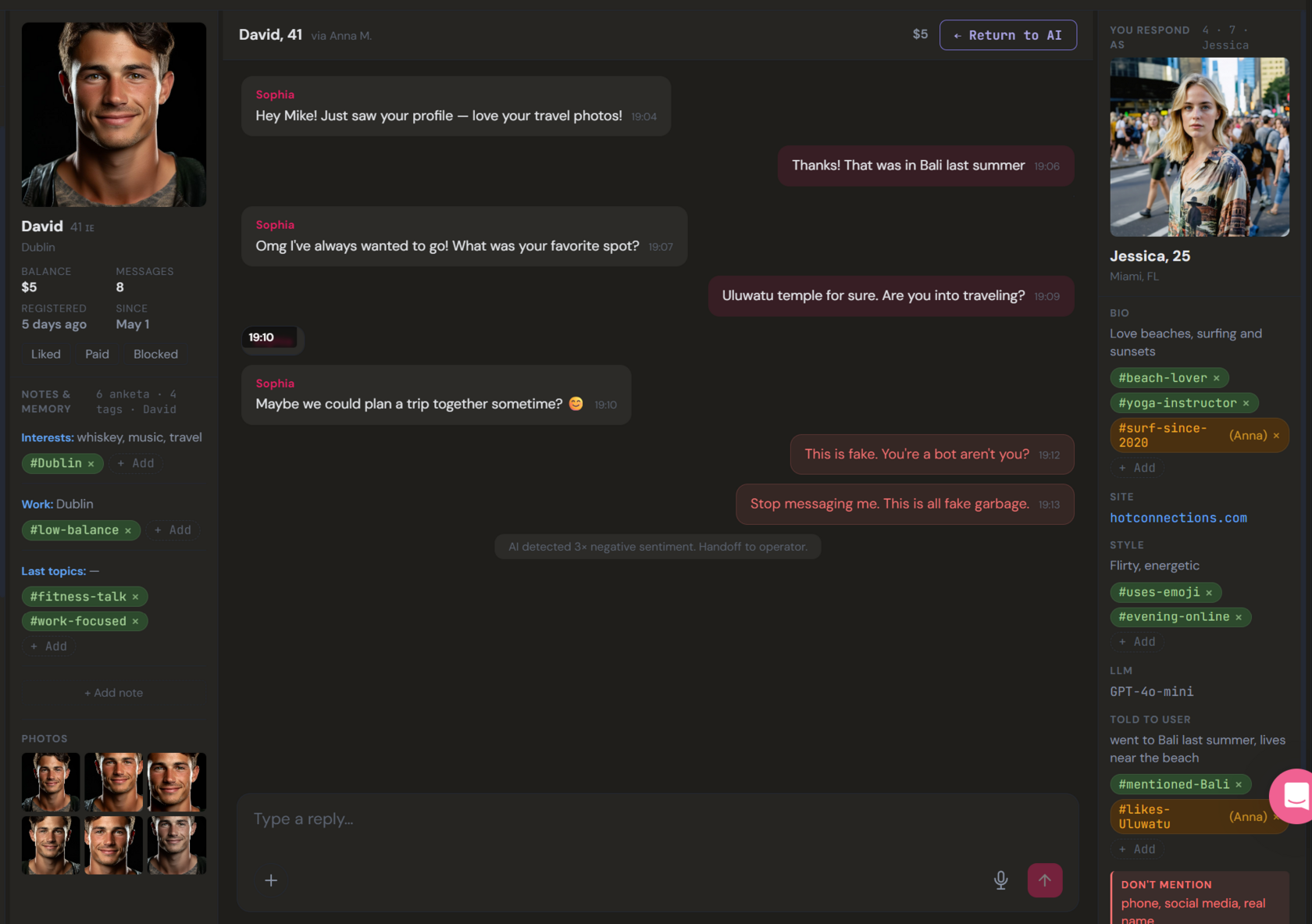
The AI guarantees the first reply. Nobody lands on an empty product. The first conversation happens within seconds of signup, every time, for every user, at three in the morning on a Tuesday. This is the design we build for you — the operator queue and the AI drafting behind it are in production today, the automatic guarantee on top of them is part of your build.
The real people supply the ceiling. For the user who wants to know someone is actually there, someone actually is — and the AI conversation becomes the warm-up rather than the whole product.
Every character is labelled. An AI companion carries an AI badge. A real person carries a real-person badge. This is not a compliance footnote in grey text; it is on the card, in the catalogue, before the click. The compliance section below explains why this is now the law in a growing number of US states, and why building it in from day one is cheaper than adding it later.
Operators sit in the middle. The underlying platform includes an operator system: a human sees a reply the AI has drafted, edits or approves it, and sends. There is a queue, a moderation layer, payouts and analytics. If your model involves staffed conversations, that machinery exists and has been used in production.
This is what an ai companion platform for dating sites looks like when it is built by people who ran dating sites first. The AI is not the product. The AI is what stops the product being empty.
What your team gets, on the other side of the screen
Everything above is what your users see. This is where your staff will actually spend their day, and it is the half that most vendors in this category never show you — because they do not have it.
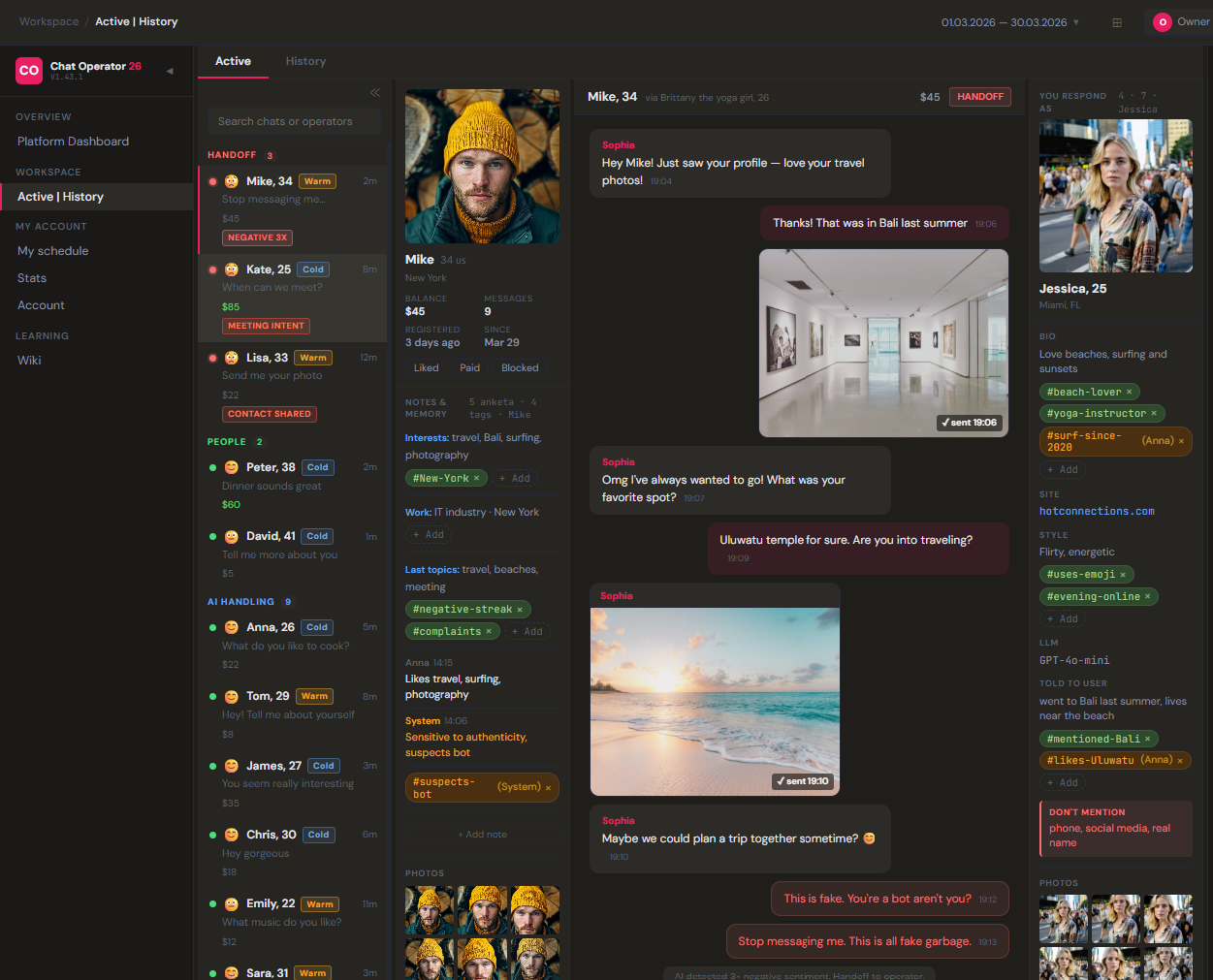
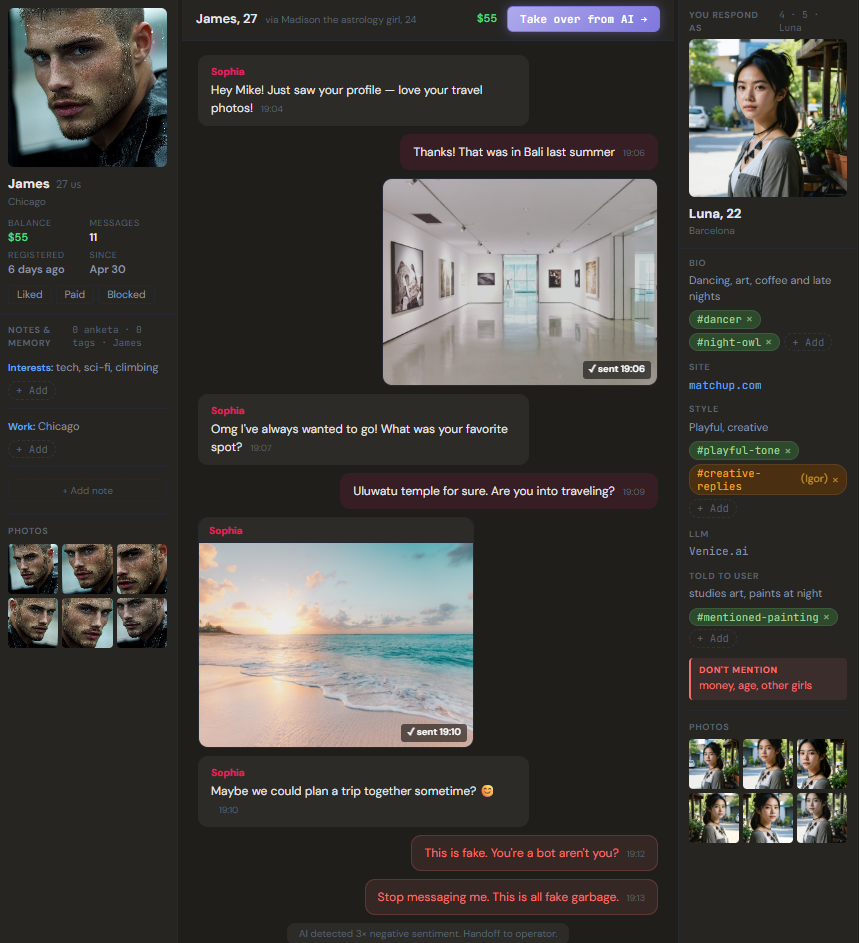
That queue is the bridge from the section above, in working form. The AI carries the ordinary conversation. When something happens that a machine should not handle alone, it stops and calls a person, and the reason is written on the card.
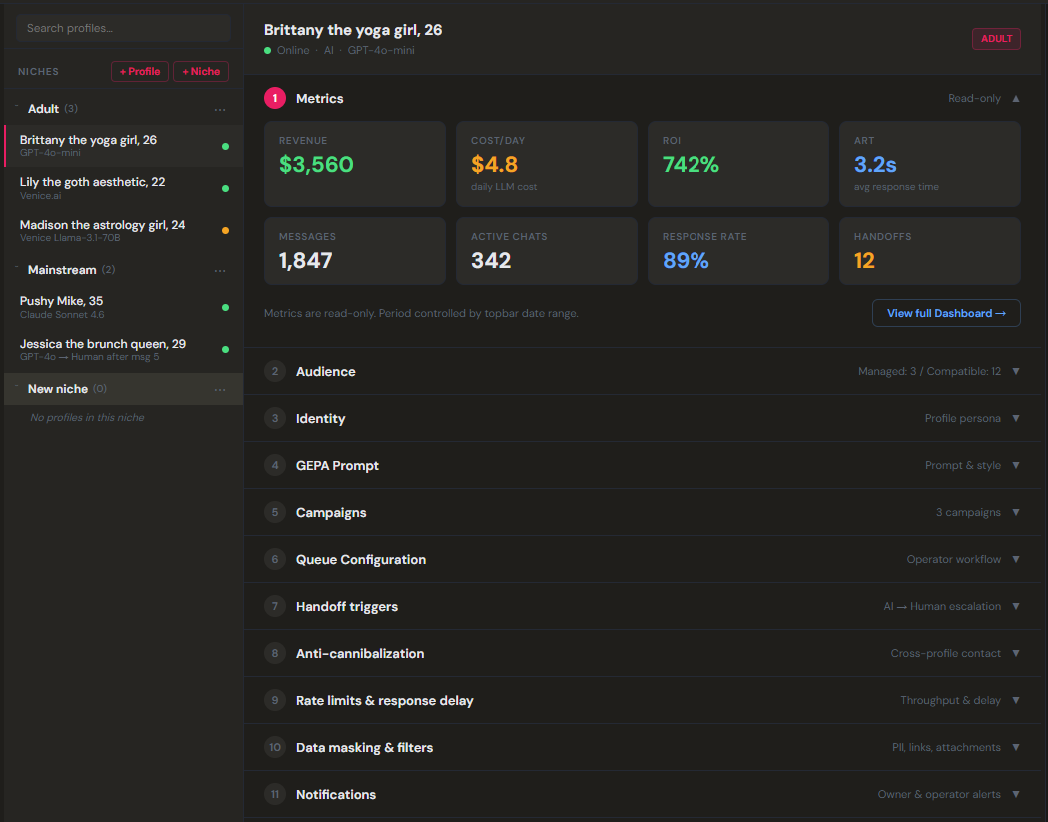
This is the screen your content manager lives in. On Monday morning they add three characters, rewrite the opening line on a fourth, and switch off one that is not working. None of that is a development task, and that is the difference between a product you own and a product you have to book time with an agency to change.
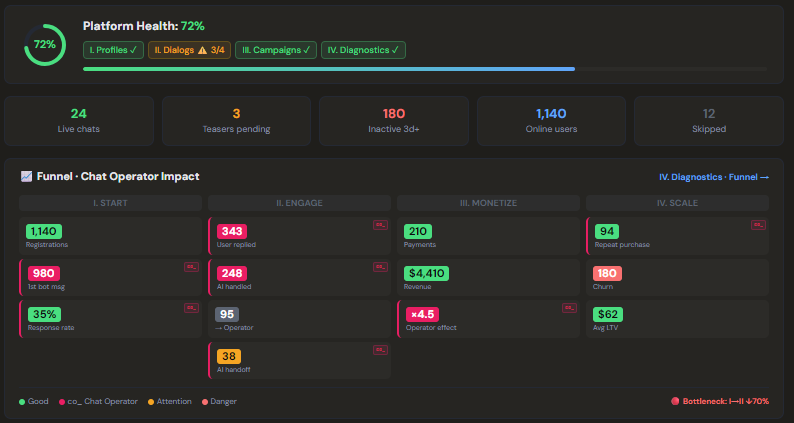
That last screen looks like paperwork and it is the one that keeps you in business. The compliance section below explains why.
Three ways to get there
There are three honest routes into this market, and only one of them is us. Here they are with real numbers.
Build it yourself
You hire developers and write it from scratch. Full control, no licence, no partner.
Realistically: six to twelve months, a team of four to six, and the majority of that time spent on billing, moderation, admin and phone apps rather than on anything a user would call AI. If you have never shipped a payment system for an adult-category product, add time for the parts you have not met yet.
This makes sense if the platform is the company — if you are building something that has to be structurally different from everything on the market, and you are funded to do it.
Buy a clone build
You pay an agency to reproduce an existing product. This is what most ai girlfriend app development and ai companion app development shops sell, and it is the usual answer to "how do I build ai girlfriend app of my own". Market pricing for this runs from $15,000 to $42,000 depending on scope, with quoted timelines from three weeks to two months.
This makes sense if you are starting from zero, you want a product shaped exactly like a specific competitor, and you are comfortable being the first user of the code you receive.
Extend a platform that already runs
You start from a working dating platform with live paying users, and add the companion layer. The billing, moderation, admin, phone apps and servers are not written — they are inherited.
Custom builds from $15,000, three to six weeks. Before that, a $499 prototype, credited against the build.
This makes sense if you already have traffic, an audience, or a dating product that needs a reason for people to come back — and if you would rather spend your budget on what makes your product different than on rebuilding a login screen.
| Route | Time | Money | Who it suits |
|---|---|---|---|
| Build it yourself | 6–12 months | A team of 4–6 | The platform is the company |
| Buy a clone build | 3 weeks – 2 months | $15,000–$42,000 | Starting from zero, copying a specific product |
| Extend a running platform | 3–6 weeks | From $15,000, after a $499 prototype | You have traffic or a dating product already |
How to build an AI girlfriend app: the short version
Whichever route you take, the order of operations is the same, and getting it wrong is the most expensive mistake in this category:
First, settle the money model — subscription, tokens, or both — because it determines the product, not the other way round. Second, settle payments, because in this category the payment company decides what you are allowed to build. Third, build the tools that keep bad content out, because that is the condition for keeping the payment company. Fourth, build the companion experience. Fifth, add generated pictures and video.
Most first-time builders do this in reverse, spend four months on beautiful generated images, and then discover that nobody will process their payments.
Will you actually earn? Run your own numbers
Real category benchmarks, with AI model costs and churn factored in.
Base calculator assumes 100% AI responses. For adult sites that add human operators, cost includes operator hours — that mode is coming and uses your per-hour operator rate. Benchmarks are category ranges; ARPPU is a derived proxy. AI apps churn faster than non-AI apps, so the result weighs retention, not just sign-ups. Your numbers will vary with traffic and niche.
Pricing: three ways in
You should not spend $15,000 on a decision you cannot picture. So the first step is small and it is real, and each step after it contains the one before.
Prototype
$499
Your product, built and clickable, in two to four working days.
- Your brand, colours and name on the working platform
- Your companion concept and your pricing model
- An exact quote for the full build
- Credited in full against whatever you buy next
Founding access
$2,990/yr
Your brand on our engine. Founder price locked. Eight seats.
- Everything in the $499 prototype
- Hosted white-label — your brand, your domain
- Token wallet, subscriptions, revenue panel
- Full source code — first eight seats only
- New features ship to founding members as they go live
Custom build
from $15,000
Your own front end and your own feature set, built to your spec. Three to six weeks.
- Everything in Founding access
- Front end and design built for you, not themed
- Your own feature set, quoted per project
- Full build and launch
Only eight founding seats. Each one keeps the founder price and the source code.
Why the top tier costs five times more. Founding access puts your brand on our screens. A custom build gives you screens nobody else has. If your product is different from ours in shape, and not only in colour, that difference is what you are paying for.
What $499 buys
We build a prototype of your product. Your brand, your colours, your name, your companion concept, your pricing model, on the working platform. Not a mockup image — a thing you open in a browser and click.
With it you get an exact quote for the full build: scope, price, timeline, and what is standard versus what is extra work for you. The $499 is credited in full against whatever you buy next — Founding access or a custom build.
Turnaround is two to four working days.
Tell us your budget
Tell us your budget when you write. Not so we can spend all of it — so we build the right prototype.
A $15,000 build and a $60,000 build are different products. If we guess low, you see a demo that undersells what you could have had. If we guess high, you see a demo of something you cannot buy. Either way you lose a week. One number fixes that.
What happens next
If you go ahead, the $499 comes off the build price. If you do not, you keep the prototype and the quote, and you have spent $499 to find out what a $15,000 decision actually looks like. That is the cheapest way to be wrong that we can offer.
Why there is a floor at $15,000
Because below it we would be doing worse work and charging you for it. A build at that scope is three to six weeks of a team's time. Quoting less would mean cutting the parts you would only miss after launch — how well bad content is kept out, how ready you are for the payment company, the admin tools your staff live in.
If your budget is under $15,000, you are not out of options and you do not have to leave this page. That is what Founding access is for: your brand on our engine at $2,990 a year, without the custom front end. And if even that is more than the idea is worth today, say so in the chat and we will point you at the licensed Dating Pro platform instead. Nobody gets sold a custom build they do not need.

What works today, and what we build for you
Every vendor in this category blurs this line. We are going to draw it.
Working today, in production, with real users
Sign-up & login User profiles Search & filters Chat Long-term memory Subscription billing iPhone & Android Admin & figures Content tools & records Operator system Several languages Servers at scale
Signing up and logging in. User profiles. Search and filtering. Chat. A companion that remembers earlier conversations. Monthly subscription billing. iPhone and Android apps. An admin panel with revenue figures. The tools that keep bad content out, and the written record of every action taken. The operator system — the AI writes a draft, a person checks it, the queue and the payouts run underneath. Several languages. Servers that have been carrying live dating sites for years.
You can see the consumer-facing shape of this in the storefront, and the underlying platform is live at soulcompanion.net.
Built for you, as part of your project
Companion creation screen Token wallet Guaranteed first reply Generated pictures Generated video Voice & calls Group chat 3+ Telegram bot Crisis detection
The screen where your users build a character. The token wallet and the price per action. The guaranteed first reply. Generated pictures. Generated video. Generated voice and voice calls. Group conversations with more than two people in them. The Telegram bot. Spotting a conversation where someone may be about to hurt themselves, and getting them to help — the requirement described in the compliance section. Any character behaviour specific to your brand. Any connection your market needs.
These are real engineering. They are quoted per project, and they are the reason a custom build starts at $15,000 rather than $500.
Not offered, so you do not have to ask
No real-person cloning No invented case studies
We do not copy real people. No likeness of a famous person, no influencer replica, no "make it look like her". This is a legal position, not a taste one, and it is not negotiable at any price.
We do not have case studies for launched AI companion products, because we have not launched one yet. Several pages you will find in this search will show you logos of well-known companion apps as their clients. We cannot check those claims and we are not going to compete with them by inventing our own. What we have instead is a platform you can open right now and a dating business with years of live clients — and we would rather you judge us on the thing that opens in a browser tab.
The detail, if you want it
Three sections that answer the questions a serious buyer asks second. Open the ones that matter to you. Nothing here is a summary — it is the full text.
The parts you do not have to build the engine
This section is the boring one, and it is the one that decides whether your launch takes six weeks or nine months. Every line below is a thing that already exists, and every one of them is a thing somebody would otherwise have to write from scratch.
The chat and the model behind it
The replies are written by a language model — the same kind of software that powers the chat assistants you already use. Which one is a choice, not a fixture. You can rent one from a big provider, or run an open one on your own servers. If your product allows adult content, you will almost certainly run your own, and that single decision moves your monthly server bill more than anything else on this page.
Pictures
The picture models used across this category are SDXL, Flux, Pony and their variants. Each one draws in a different style, and each one has a different tolerance for adult content. Choosing between them is part of the build conversation. Connecting one is work we do for your project, not a switch that is already on.
Video
Same picture. Kling, Wan and Hailuo are the names that come up. A single video clip costs enough to generate that your token prices have to be worked out around it rather than guessed. Also work we do for your project.
Voice
The companion speaks: voice notes and calls, with a different voice per character, so she sounds like herself and not like a narrator reading a script.
The wallet
Balance, top-ups, a price per action, a history of what was spent, refunds. The payment machinery underneath is already handling real money on live sites. The wallet on top of it is built for your product.
Monthly plans
Subscriptions alongside the wallet, with the two working together sensibly — a plan can include a monthly allowance of tokens, unlock a discount, or lift a limit.
Keeping bad content out
Word filters, detection of what a message is really asking for, different rules for different countries, blocks on generating famous people, filters on what users type into the character creator, a report button, and a record of every action your staff took. That last part is not decoration. It is the difference between keeping the company that processes your payments and losing it.
The admin panel
Where your staff live: users, content, characters, revenue figures, how each operator is performing, the queue of reported messages.
Telegram
A Telegram bot as a second front door. For a large part of this audience Telegram is where they already are, and a bot removes the install step entirely. This one is built to order, not switched on — your own version, quoted with the build.
Other languages
The platform speaks several languages already. Translating your characters and your content is part of the build.
Phone apps
iPhone and Android, on the existing platform.
Handling the load
The servers have been running production dating sites for years. This is the least exciting line in this section and the one you would miss most at two in the morning on your first busy weekend.
How AI girlfriend apps make money five revenue streams
Five revenue streams. We are not going to invent numbers for how much you will earn, because we have not run this product at scale and anyone showing you a projection for your audience made it up. What follows is the mechanics; the arithmetic is yours to run on your own traffic.
Subscriptions. A monthly fee for access, usually in tiers. Predictable, easy to forecast, and capped — a subscriber cannot spend more than their tier no matter how engaged they are.
Tokens. A wallet the user tops up and spends on individual actions: generating a companion, unlocking a photo, a voice note, a video, a minute of call time. Uncapped by design. This is where the engaged minority of any companion product spends, and in most consumer products with both models, that minority produces most of the revenue.
Generation as a product. Charging for the creation of a companion, additional looks, or custom content. Different from unlocking, because the user is commissioning something rather than revealing it.
Affiliate and referral. Paying partners to send traffic, and paying users to bring friends. In adult-adjacent categories this is a main way of getting customers rather than a nice-to-have, because most mainstream ad networks will not take your money.
The bridge. Charging for guaranteed conversation with real people — the mechanic from the section on AI and real people together. This one only exists if you run both sides, and it is the one your competitors structurally cannot copy.
The reason to have both a subscription and a wallet is the same reason a cinema sells tickets and popcorn. The ticket is predictable and gets people through the door. The popcorn is where the margin is, and nobody feels overcharged for buying it.
Age, AI labelling, moderation and payments the part that decides whether you can take money
This section is longer than you expect it to be, and that is the point. In this category, the rules are not paperwork you handle after launch. They decide whether you can take money at all.
We are not lawyers and nothing here is legal advice. What follows is what we build, and what we have seen decide whether a project survives.
Telling users they are talking to a machine is now the law
Between 2025 and 2027, US states started writing rules for AI companions specifically — not AI in general, but chatbots that act like a person and hold a relationship with someone.
| State | Law | In force |
|---|---|---|
| New York | General Business Law, Article 47 | 5 Nov 2025 |
| California | SB 243 | 1 Jan 2026 |
| Colorado | SB 24-205 | 30 Jun 2026 |
| Tennessee | SB 1580 | 1 Jul 2026 |
| Oregon | SB 1546 — users may sue, $1,000 per violation | 1 Jan 2027 |
| Washington | HB 2225 — users may sue | 1 Jan 2027 |
| Nebraska | LB 525 | 1 Jul 2027 |
| Idaho | SB 1297 | 1 Jul 2027 |
What they ask for is much the same in each state. Tell the user, clearly and more than once, that they are talking to a machine. Keep children out, and keep sexual content away from them. Notice when a conversation turns towards self-harm, and point the person to help. Do not let the character claim to be a therapist.
Two of those states — Oregon and Washington — let a user take you to court directly. In Oregon the amount is written into the law: $1,000 for each breach. The user does not have to prove they lost money. The breach itself is enough.
What this means for you. A platform that hides its AI label in small grey text at the bottom of the page is selling you a bill that arrives in eighteen months. Ours labels every AI character on the card, in the catalogue, before the user clicks — because we decided that was the honest way to build it, and the law has since agreed. Adding that label to a product whose whole appeal was the doubt is expensive. Starting with it costs nothing.
Spotting a conversation about self-harm and routing the person to help is work we do for your project today, not a finished feature. We are telling you that plainly rather than letting you find out during a review.
Age
Nobody can build a companion under 18. It is not a checkbox the user ticks — the interface will not let the number go lower.
Checking the age of your own users is a separate layer, and how far you have to go depends on your market and on what your payment company asks for. It is part of the build conversation, not an afterthought.
Keeping bad content out
Word filters. Detection of what a message is really asking for. Different rules for different countries, because what is allowed is not the same everywhere. Blocks on generating famous people. Filters on what users type into the character creator. A report button. And a written record of every action your staff took.
That last one matters more than it sounds. When a payment company or a regulator asks what you did about a specific complaint, the answer has to be a line in a log with a date on it, not somebody's memory.
Payments — the part that kills projects
The payment companies most businesses use do not accept this category. Stripe, PayPal and Razorpay will turn you down, and if you build for four months assuming otherwise, you will find out at the worst possible moment.
You will work with a company that specialises in adult businesses — CCBill, Segpay or something comparable. Whether they say yes depends on your company, your country, what content you allow and how you handle complaints. It does not depend on us, and we will not promise you an approval we cannot deliver.
Expect the application to ask for company documents, proof of who actually owns the business, identity checks on those people, a written policy on what content you allow, and a demonstration of how you deal with complaints.
Expect one more thing that surprises first-time founders: for the first few months the payment company keeps back a slice of every payment — often five to ten percent — and holds it for six months. It is their insurance against customers demanding their money back later. It is normal, it is temporary, and it means the cash arriving in your account in month one is smaller than the sales figure on your dashboard. Plan around it instead of being surprised by it.
How explicit your product is — whether you run adult content at all, and how far it goes — is a decision to make before you pick a payment company, not after. It changes who will take you, which language model you can use, and whether you have to run that model on your own servers. We will ask you this question in the first conversation because everything else depends on the answer.
What we do is build the platform so it passes their review: an age limit that is actually enforced, content tools with a record you can produce, clear AI labelling, working refunds, a process for when a customer disputes a charge with their bank, and transaction records that add up. Every one of those is something they ask about.
Visa and Mastercard rules apply to any payment company inside their networks, whichever one you sign with. Plan your content policy around that from the start, not after the first rejection.
Data
Handled the way European data law expects: you know what you keep, you know how long you keep it, and deletion actually deletes. Standard, but worth confirming before you sign anything with anyone.
FAQ
Is this a Candy AI clone?
No. A clone is a from-scratch rebuild of a specific product, and several agencies sell exactly that for $15,000 to $42,000. We start from a dating platform that already runs live sites with paying members and add the companion layer on top, so the billing, moderation, admin and mobile are inherited rather than written. If you want a pixel-level reproduction of a particular competitor, a clone shop is a better fit. If you want a product of your own on infrastructure that already works, this is.
I use Candy AI. Can I run my own version of it?
Yes, and this is the most common way people arrive here. You have spent money inside one of these apps, you have opinions about what it gets wrong, and you want the version you would have built. That is a business, not a hobby, and it is what a Candy AI alternative under your own brand actually is. What you are buying is the machinery: the chat, the profiles, the wallet, the billing, the moderation, the phone apps. What you bring is the part that makes people choose yours — the characters, the tone, the price, the audience you already talk to. The starting point is a $499 prototype with your brand on it, and an exact quote for the rest.
What is the difference between a Candy AI clone and a white-label platform?
A clone is a copy built for you from an empty folder. Someone writes every screen again, including the boring ones, and hands you code that has never had a real user on it. A white-label platform is a product that already runs, with your name on the outside. Same idea as a supermarket's own-brand pasta: one factory, twenty brand names, and the shopper only sees the box. The clone gives you a shape you choose completely and a bill for every screen. The white-label gives you the finished machinery on day one and a structure you did not design. We are the second one, and we say so plainly rather than selling you the word you searched for.
How is this different from Replika, Nomi, Kindroid or DreamGF?
Those are apps you use. This is the thing you use to build an app like them. Replika, Nomi, Kindroid and DreamGF each sell a single product to millions of consumers, and none of them will let you run your own version with your own brand, your own prices and your own payout account. That is the whole difference. If you arrived here searching for a replika clone, a dreamgf clone or a character ai clone, you are looking at the same question from a different angle: you do not want another account, you want the thing underneath. If you want to talk to a companion, use one of them. If you want to own one, own the users and keep the revenue, that is this page.
Who are the Candy AI competitors, and should I copy one?
The names that come up most are Replika, Nomi, Kindroid, DreamGF, Character AI and a long tail of smaller apps. Looking at the candy ai competitors is useful for exactly one thing: seeing which ideas already have paying users behind them. Copying one is a different decision, and usually a poor one, because you arrive second with the same product and give nobody a reason to switch. The version worth building is the one that serves an audience you can already reach — a language, a country, a niche, a mailing list, a community you already run. The engine is the same either way. The audience is what makes it a business.
Do you sell a Candy AI clone script I can install myself?
No, and it is worth knowing why. A script is a folder of code you put on your own server, and from that moment every crash, every failed payment and every model that stops answering at three in the morning belongs to you. It is cheap on day one and expensive on day ninety. What we sell instead is the running platform — hosted under your brand, or built out to your spec — with the people who wrote it still on the other end of it. If you specifically want code you own, that is what the first eight founding seats are for.
Can I see it working before I pay anything?
Yes. Fill in the short form and the last screen of it hands you the link to the working storefront. No phone call, no booked meeting, no waiting for someone to get back to you. It runs on made-up data and it labels the buttons that are placeholders. Click everything.
What does $499 actually get me?
A prototype of your product — your brand, your concept, your pricing model, on the working platform — plus an exact quote for the full build. Two to four working days. The $499 is credited in full against whatever you buy next, and the prototype is yours to keep if you buy nothing.
Why is the minimum build $15,000?
Because a build at this scope is three to six weeks of a team, and quoting less would mean cutting the parts you would miss after launch rather than before it. If your budget is lower, you do not need a custom build yet: Founding access puts your brand on the same engine for $2,990 a year without the custom front end. Below that, the licensed Dating Pro platform is likely the right product and we will say so.
Can you generate images and video?
Connecting an image or video model is work we do for your project and quote separately. It is not a switch that ships turned on. The list above shows exactly what works today and what is built for you. We are not going to blur that line to make this page read better.
Can I make a companion of a specific real person?
No. No public figures, no influencer replicas, no likeness work. This is not negotiable at any price.
Do I need a special payment processor?
Yes. Stripe, PayPal and Razorpay decline this category. You will work with a payment company that specialises in adult businesses, such as CCBill or Segpay, and whether they say yes depends on your company, your country and how you handle complaints. We build the platform to pass their technical review; we do not promise the approval itself.
How is the AI labelling handled, and is it required?
Every AI character carries an AI badge on the card, in the catalogue, before the user clicks. As of 2026 it is also the law in a growing number of US states, two of which let a user take you to court over it directly. Building it in from the start costs nothing; adding it to a finished product later is expensive.
Open it, then decide
You have read a page. Pages are easy to write.
The storefront: one short form, and the last screen gives you the link. The prototype: $499, credited against your build.
- ROI calculator. Estimate your earnings
- Branding. Connect domain
- Dating website templates
- Explore free business tools
- Buy & sell dating sites and domains online
Solutions
- How to start a dating site or app — free niche preview
- Create a dating app (iOS, Android, web)
- Custom dating app development — done for you
- Dating software to build your own dating site
- Telegram dating bot
- White-label AI girlfriend builder — Candy AI clone
- Chat Operator 26 — Chatbot Software with AI Agents and Human Operators for Dating Platforms
- Chat Operator Dating Site
- Matchmaking software for your custom service
- Dating platform built for AI coding agents
Company details:
PE Evdokimov Ianar Yuri
Armenak Armenyakyan street 121/7, 0047, Yerevan, Armenia
Office Address:
🇵🇱 Poland: ul. Mazowiecka 11/49, 00-052 Warsaw
🇦🇲 Armenia: Armenakyan Street 121/7, 0047 Yerevan